
Scalper Pro v4
Most scalping tools fire on every candle and leave you to sort out which signals were worth taking. Scalper Pro is designed to do that filtering first - it stays silent until trend, momentum, volume and market structure agree, then marks the entry with a full trade plan.
Key benefits
- Fewer, better-qualified signals - every setup is graded 0-100 and anything below your minimum score never reaches the chart
- No guesswork on risk - each signal arrives with an entry, an ATR-based stop loss and up to three R-multiple targets already drawn
- Built-in sideway protection - signals are blocked when the market is range-locked or the EMA structure goes flat
- Fewer whipsaws - an anti-flip filter stops the indicator from reversing its own call unless the new signal is materially stronger
- Session control - restrict signals to Asia, London, New York, killzones or a custom window
How it works
Three setups can trigger a signal - trend continuation, reversal at a demand/supply pivot with RSI divergence, and breakout-retest confirmation. Each is scored against trend alignment, ADX, RSI, volume and higher-timeframe bias, and only the strongest qualifying setup prints. Signals confirm on candle close. Full logic is in the Manual.
What's included
TradingView version (invite-only script access).
Best for
Intraday scalpers on M5-M30 trading gold, indices, crypto and major FX pairs - XAUUSD, NAS100, BTCUSD, EURUSD and similar - who want a selective, rules-based entry model rather than constant signals.
Get access
Browse the ZynAlgo marketplace
Trading involves risk. This indicator is for educational purposes only and does not guarantee results.
Scalper Pro v4
Why Scalper Pro filters more than it signals
Scalper Pro is an intraday scalping indicator for TradingView built on a simple idea: on low timeframes the hard part is not finding entries, it is refusing the bad ones. Instead of reacting to every candle, it stays quiet until several independent conditions agree on the same direction.
Each closed candle is measured against:
- Market structure - whether recent swing highs and lows support the direction
- Trend alignment - how EMA 20, 50 and 200 are stacked, and which side of EMA 20 price is holding
- Momentum - RSI 14 for direction quality, ADX for trend strength
- Participation - current volume against its 20-period average
- Range conditions - a sideway lock that blocks signals when the market is compressed or the EMAs go flat
Only when these line up does a BUY or SELL appear, and every signal arrives with an entry, a stop loss and up to three take-profit levels already drawn on the chart.
The Role of the Signal Score
Most scalping tools treat every signal as equal. Scalper Pro does not. Every raw setup is graded on a 0-100 Signal Score, and that score decides whether the signal is worth putting on your chart at all.
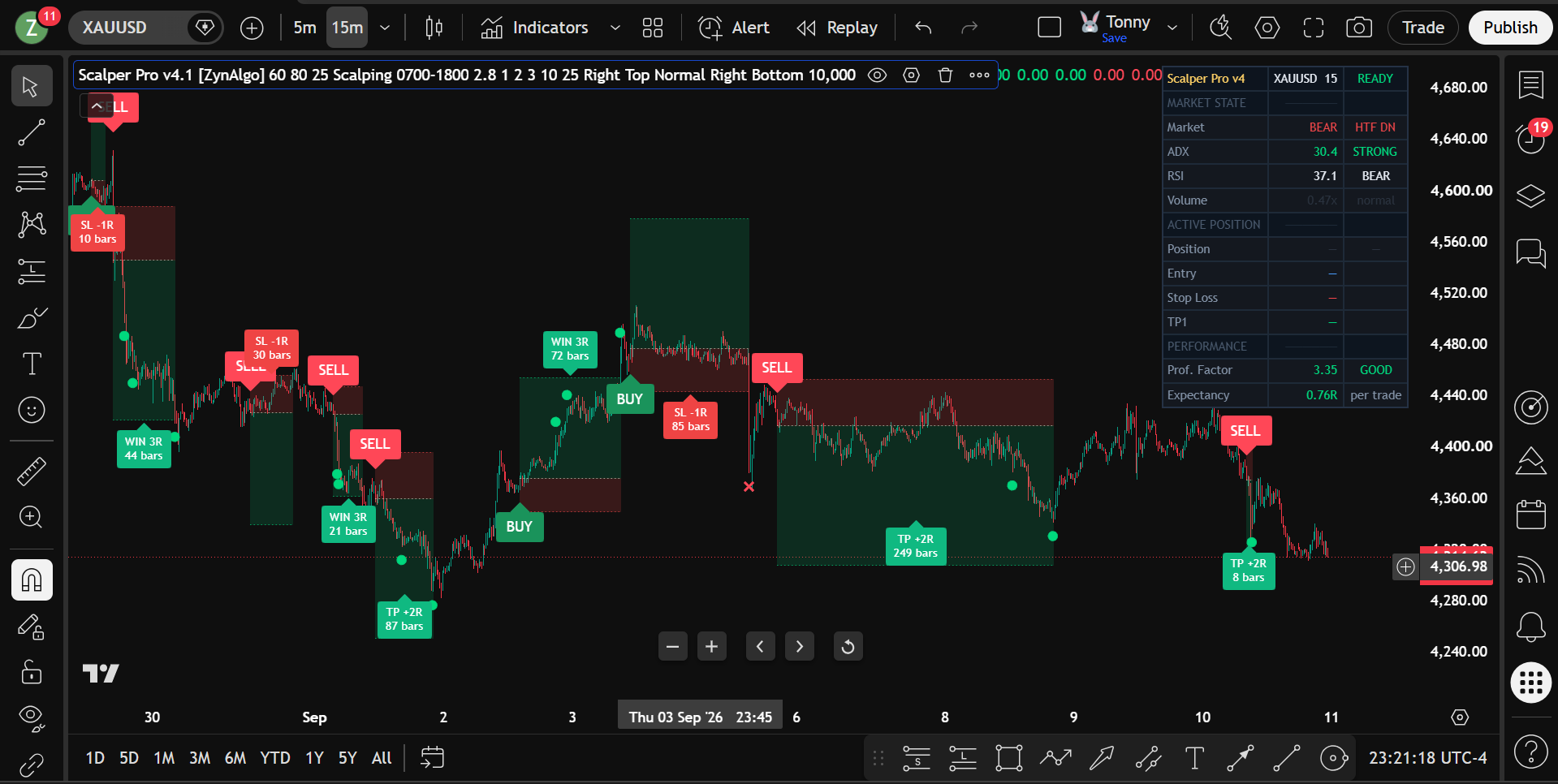
- A high score means several independent factors agree on the same direction
- A low score means the pattern printed, but context does not back it up
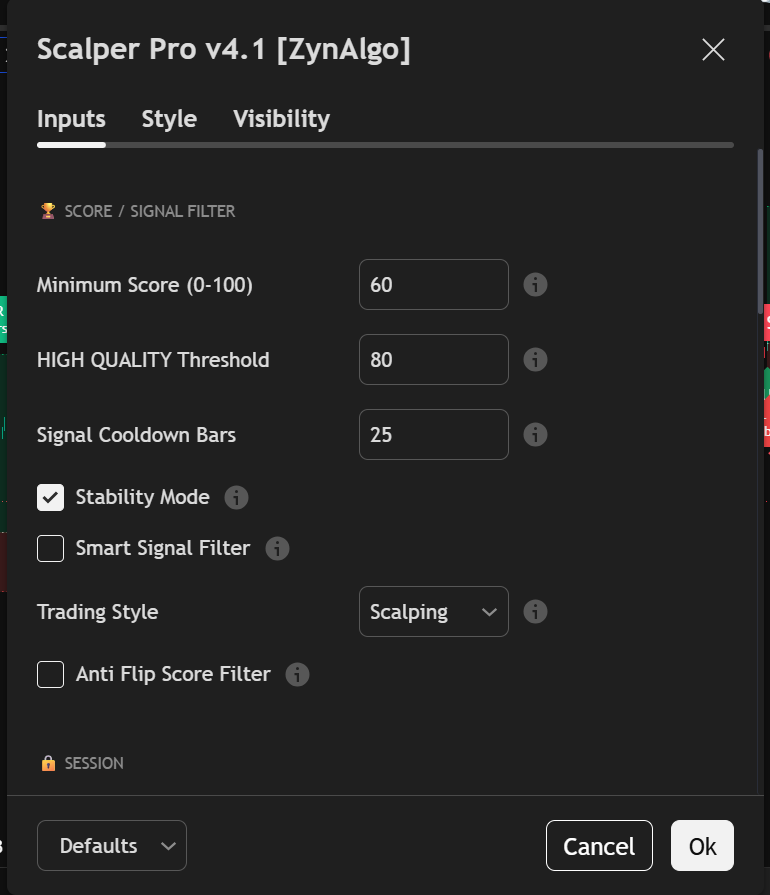
- Anything below the Minimum Score threshold (default 60) never reaches the chart
A common mistake is taking a textbook pattern the moment it prints, without asking whether trend, momentum and volume agree with it. A clean engulfing candle inside a flat, low-ADX range is exactly the trade that looks right and behaves badly.
How the Signal Score is defined
- Trend alignment - up to +20 when EMA 20/50/200 stack in order and price holds the correct side of EMA 20
- ADX - up to +20, scaled by trend strength (>=30 strongest, >=22 moderate, >=18 weak)
- RSI 14 - up to +20 when momentum sits in the working zone for that direction
- Volume - up to +15 when the candle trades above its 20-period average
- EMA 200 bias - +10 when price closes on the correct side
- Setup quality - up to +15 depending on how cleanly the triggering pattern formed
Three setups can raise a raw signal, and the highest-scoring one is used:
- C1 - trend continuation: EMA alignment, RSI in range, and an engulfing candle that closes beyond the previous candle's extreme
- C2 - reversal: price reacting at a demand or supply pivot, with RSI divergence and a volume spike above 1.3x average
- C3 - breakout retest: a 20-bar range break, then a retest held within 0.5 ATR, confirmed by Stochastic
Entry rules with Scalper Pro
A BUY or SELL label prints only after the candle closes, and only when every gate below passes.
BUY requires:
- Market is not in a sideway state
- Structure shows a higher high or a higher low
- Best BUY score reaches the Minimum Score
- Cooldown satisfied - 5 bars since the last BUY (default) and at least 3 bars since any signal
- Inside the selected session, if the session filter is enabled
SELL requires the mirror image: a bearish structure (lower high or lower low), price below the EMA structure, and the same score, cooldown and session gates.
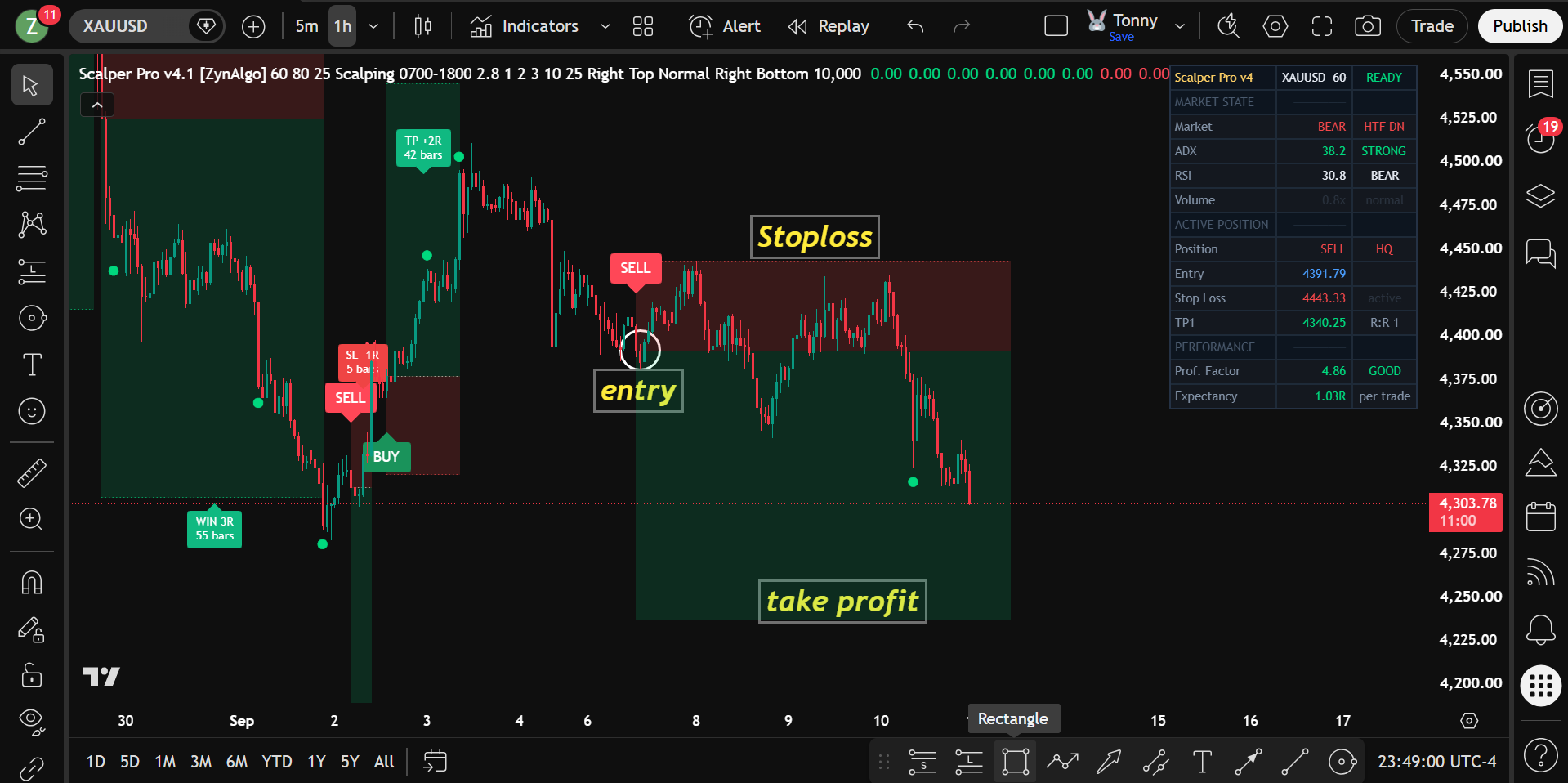
When both directions qualify on the same candle, the higher score wins. The Anti-Flip Score Filter (on by default) blocks fast reversals: within 8 bars of a signal, an opposite signal must beat the previous score by at least 12 points before it is allowed through.
Every accepted signal draws:
- Entry at the close of the signal candle
- Stop Loss at ATR(14) x Distance (default 2.8)
- TP1 / TP2 / TP3 at configurable R multiples (defaults 1.0 / 4.5 / 6.5; only TP1 is enabled by default)
Who should use Scalper Pro?
Scalper Pro suits traders who:
- Scalp intraday and are comfortable on M5 to M30 charts
- Prefer fewer, better-qualified entries over constant activity
- Want a defined stop and target attached to every signal, not just an arrow
- Trade liquid instruments during the London and New York sessions
Tested ranges: XAUUSD M5-M15 - XAGUSD M5 - NAS100 M5 - MNQ M5 - BTCUSD M5-M15 - EURUSD M30 - AUDUSD M30
Scalping is not about catching every move - it is about being selective enough that the moves you do take are worth the risk. Scalper Pro is built to enforce that selectivity for you.
Browse the ZynAlgo marketplace
This indicator is provided for educational purposes only and does not constitute financial advice. Trading involves risk; past performance does not guarantee future results.
- Scalper Pro v1Aug 13, 2026

Why My Scalp Entries Get Stopped Out Early (And How to Filter Better)
Most scalping losses happen before momentum arrives, you enter a clean pattern that the broader context doesn't support. Learn how multi-factor filtering cuts noise and waits for confluence.

Why Your Scalping Entries Get Stopped Out Before the Move Starts
Taking every clean pattern on a five-minute chart burns capital on entries that never had momentum, volume or trend behind them. This article shows you how gated signal scoring filters scalps to those worth the spread.
Why Most Scalping Entries Look Right But Behave Badly on Five-Minute Charts
You see the pattern form, the entry looks clean, then the spread and the stop hunt kill it. Scalper Pro v4 holds signals back until structure, trend, momentum and volume agree, and scores every setup before it is drawn.
Why My Scalp Entries Get Stopped Out Early and How to Filter Setups Better
You see the pattern, you take the trade, and ten bars later you're stopped for a loss while price reverses without you. The problem is not the pattern, it's taking it without context.