Renko Trend Heatmap
Standard Renko tools fix the brick size in advance, so they lag in quiet markets and shake you out in volatile ones. Renko Trend Heatmap [ZynAlgo] sizes each brick from live volatility, colours the trend by how far it has run, and only marks a reversal when the move is backed by real volume.
Key benefits
- Volatility-adaptive bricks: brick size scales with market volatility, tightening in slow conditions and widening when price expands, instead of a single fixed value.
- Heatmap by conviction: each brick is shaded on a gradient that deepens the longer the trend streak runs, so strength is visible at a glance.
- Volume-confirmed reversals: a trend flip only prints a signal when the confirming bar carries volume above its own average, filtering weak fakeouts.
How it works
Renko Trend Heatmap [ZynAlgo] runs its own non-repainting Renko engine that maps price into bricks sized from ATR scaled by current volatility. When the close pushes past the active brick boundary the trend flips, the streak counter resets, and the gradient recolours. A reversal only fires a BUY or SELL when the volume filter agrees, and a built-in dashboard tracks the resulting entry, stop, targets and performance. Full walkthrough in the Manual.
What's included / Platforms
- TradingView indicator, Pine Script v6, added to your TradingView username once access is granted. Released to ZynAlgo VIP members.
Best for
Trend and reversal traders working intraday to daily charts who want a Renko read that adapts to volatility, shows conviction through colour, and waits for volume before calling a turn.
Get started
Browse the ZynAlgo marketplace
Disclaimer: Trading involves risk. Signals, heatmap colouring and tracked statistics are analytical references only and do not guarantee future results - always trade with your own plan and position sizing.
Renko Trend Heatmap
Reading trend by heat, not by candle
Renko Trend Heatmap [ZynAlgo] is built around one idea: a Renko chart already strips out time and noise, so the job left is to make the trend's conviction visible and to only act on a turn the market actually paid for. Instead of a fixed brick size that lags in calm markets and whipsaws in fast ones, the tool sizes every brick from live volatility, then shades it on a gradient that deepens the longer the trend has run.
The philosophy is to keep the read honest. Bricks are built by a custom engine that measures each close against the last brick boundary, not by a borrowed Renko feed that can shift under you. A trend only flips when price clears a full brick, and a flip only earns a signal when the confirming bar carries genuine volume behind it. On TradingView you get a live heatmap of where the trend is running, how hard, and a full plan attached to each confirmed reversal.
The dynamic Renko engine
A fixed brick size forces one compromise on every market and every session. Set it small and calm ranges fill with noise; set it large and you give back the start of every move. Renko Trend Heatmap sizes its bricks from the market itself, so the same settings behave sensibly whether price is drifting or expanding.
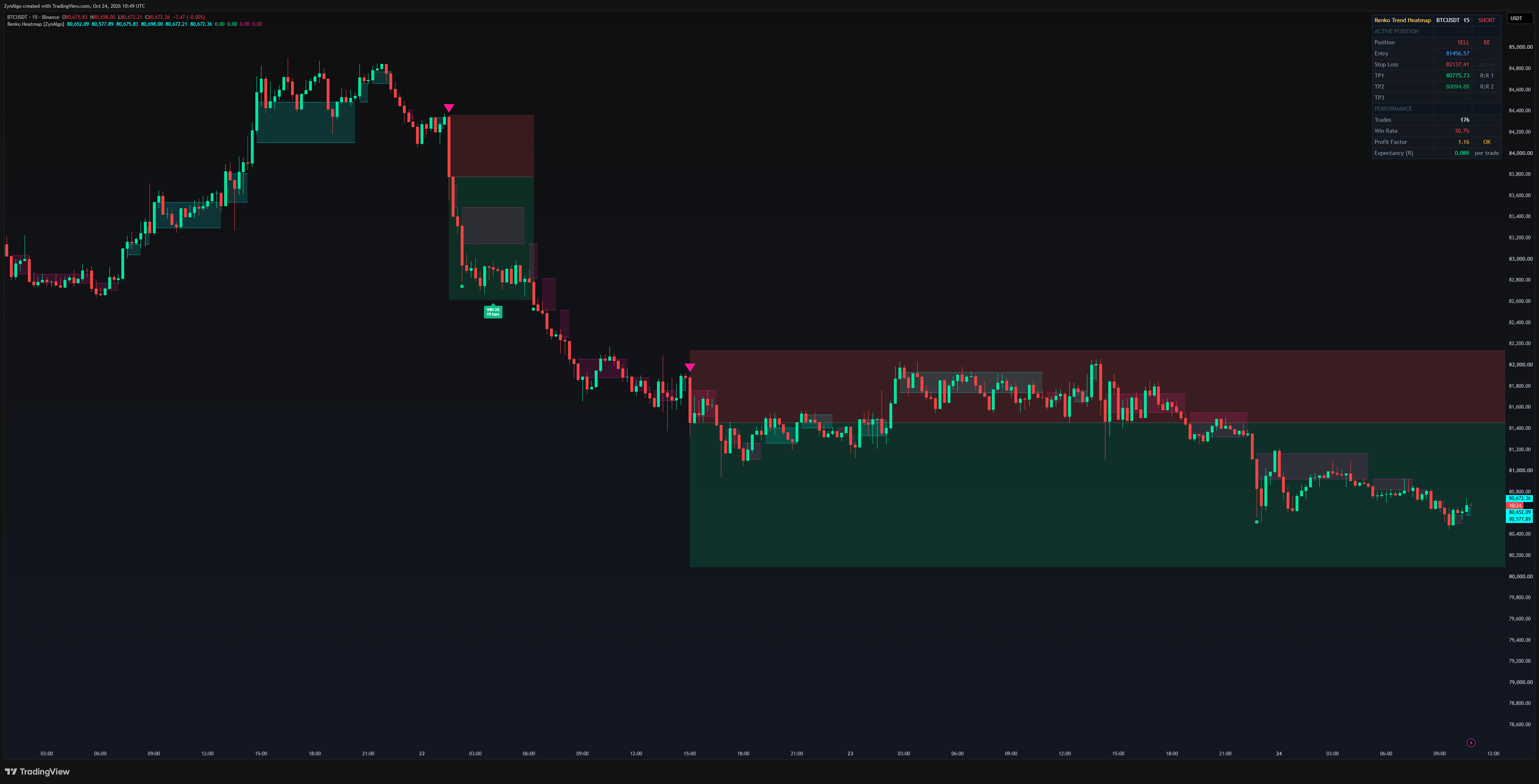
How the brick size is built:
- a Base ATR Period measures the market's normal range;
- a Volatility Lookback compares current dispersion against its own longer average to produce a scaling factor, held between 0.5x and 2.0x so it never collapses or explodes;
- the two are multiplied into the working brick size, which tightens when volatility falls and widens when it rises.
The engine is a clean, non-repainting build: each bar's close is compared to the previous brick's top and bottom, and a new brick is only committed once price travels a full brick beyond the boundary. It does not rely on TradingView's synthetic Renko feed.
The heatmap and the streak
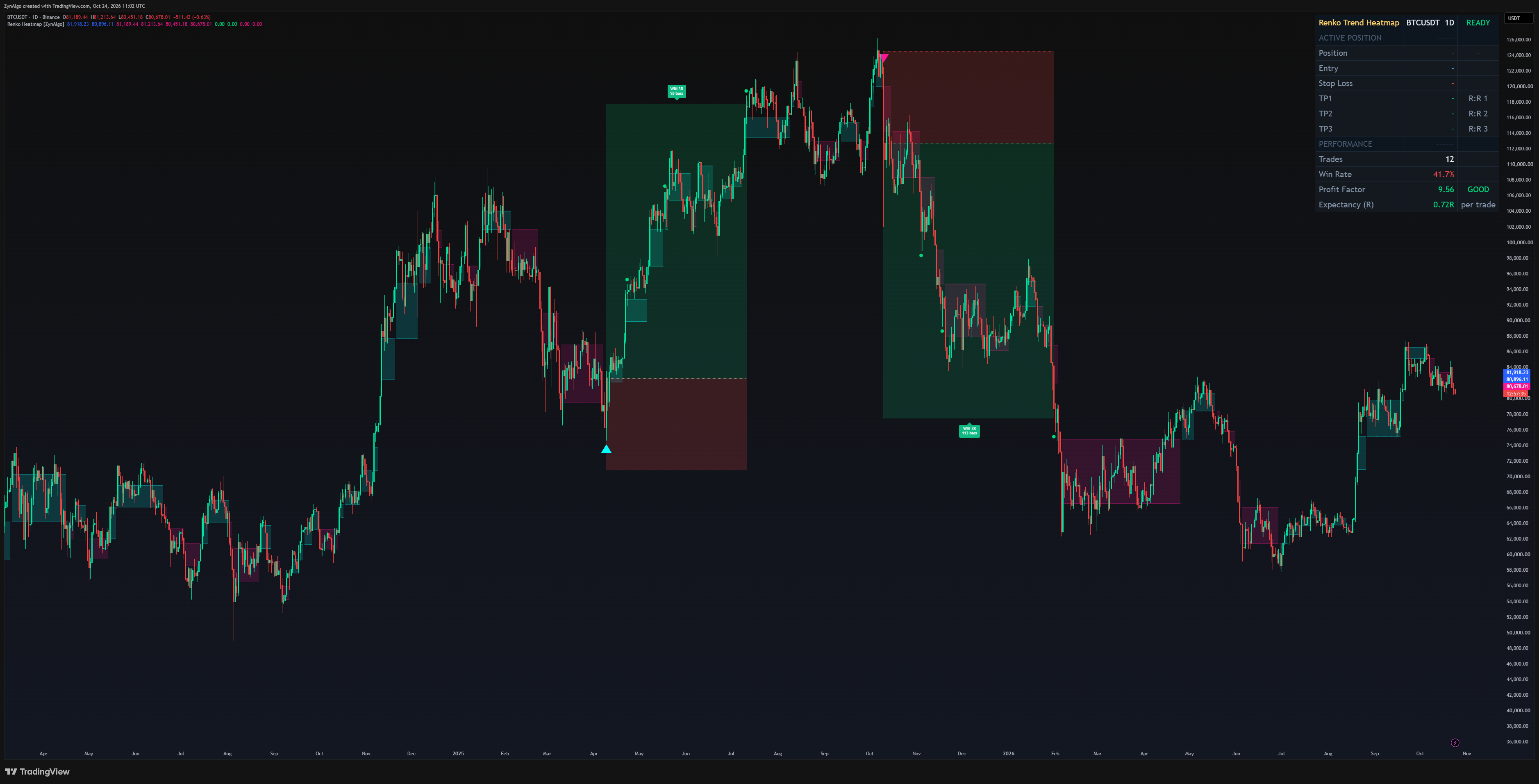
Once bricks are built, colour carries the message. Each brick belongs to a bull or a bear trend and is shaded on a gradient tied to the streak - the count of consecutive bricks in the current direction.
- Bull trend paints on the neon-blue side of the palette; bear trend on the neon-pink side.
- The longer the streak runs, the more saturated the block becomes, so a deep colour means a trend that has extended without interruption and a pale one means a turn is fresh.
- A Streak Depth setting controls how many bricks it takes to reach full saturation, so you can tune how quickly the heatmap reads as "strong".
Price itself is redrawn as coloured candles inside the zone, so the trend direction and its conviction sit together on one overlay.
The common mistake is treating every fresh brick as a trend change. A single brick against the run is just a wobble; what the heatmap is showing you is how much agreement has stacked up in one direction before you decide it matters.
The Effort vs Result volume filter
A Renko flip on its own says nothing about who was behind it. The volume filter is what separates a reversal the market committed to from one that drifted across the boundary on thin trade.
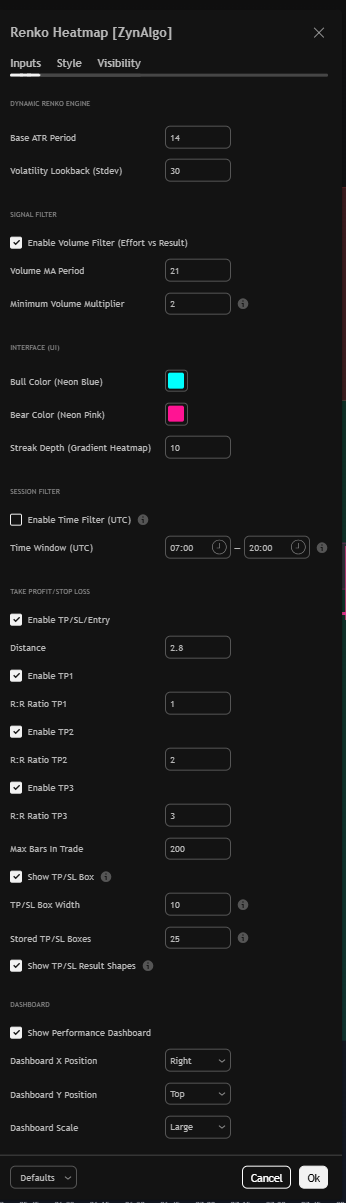
- The confirming bar's volume is compared against its own moving average.
- A reversal is only accepted when that volume is at or above the average times your Minimum Volume Multiplier - set it to 1.0 to require above-average volume, or higher to demand a stronger surge.
- The filter can be switched off entirely to show every raw Renko flip, useful on instruments without reliable volume data.
Only a flip that clears this test prints a signal. Everything else is treated as effort that failed to produce a result.
Reading the signals and the plan
A triangle only prints when two conditions line up: the Renko engine confirms a genuine trend reversal, and the volume filter agrees (unless you have turned it off). A bullish reversal prints a triangle below the bar; a bearish reversal prints one above.
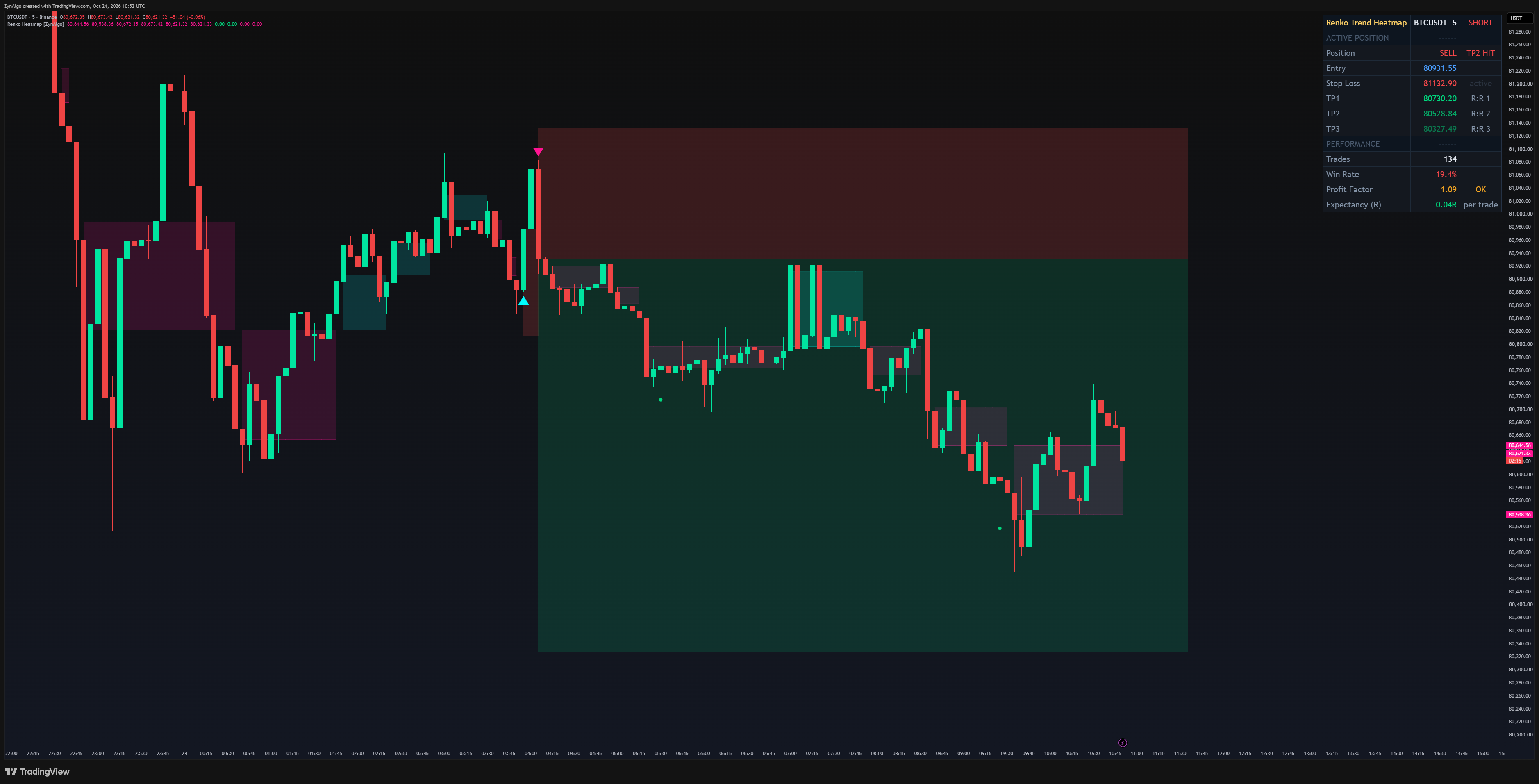
Every confirmed signal is handed to the dashboard with its levels already worked out:
- the close of the signal bar is the entry reference;
- the protective stop is placed an ATR-scaled distance away, set by your Distance input;
- up to three targets (TP1, TP2, TP3) are projected at your chosen risk-to-reward ratios, with a break-even shift after the first target is reached;
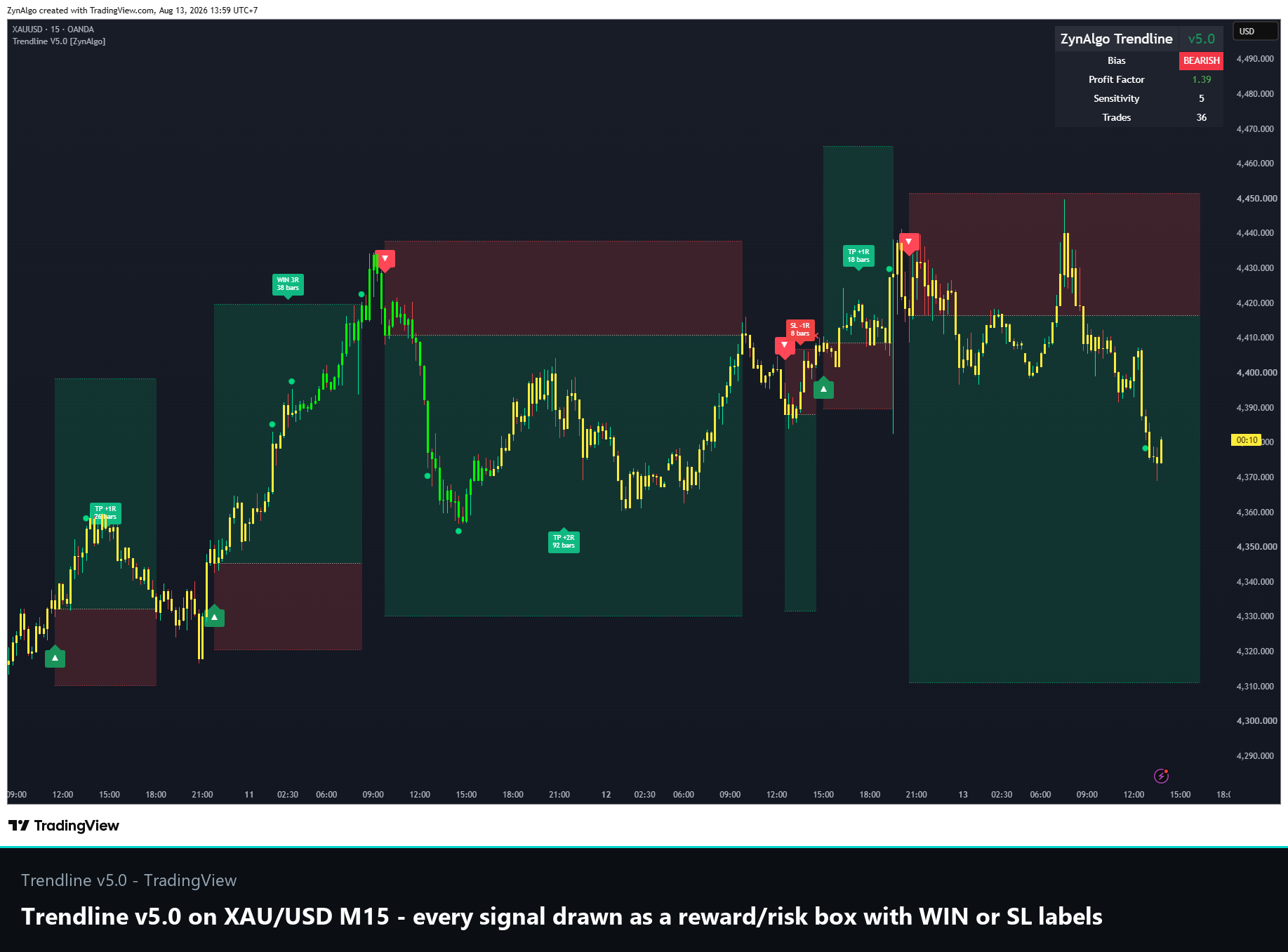
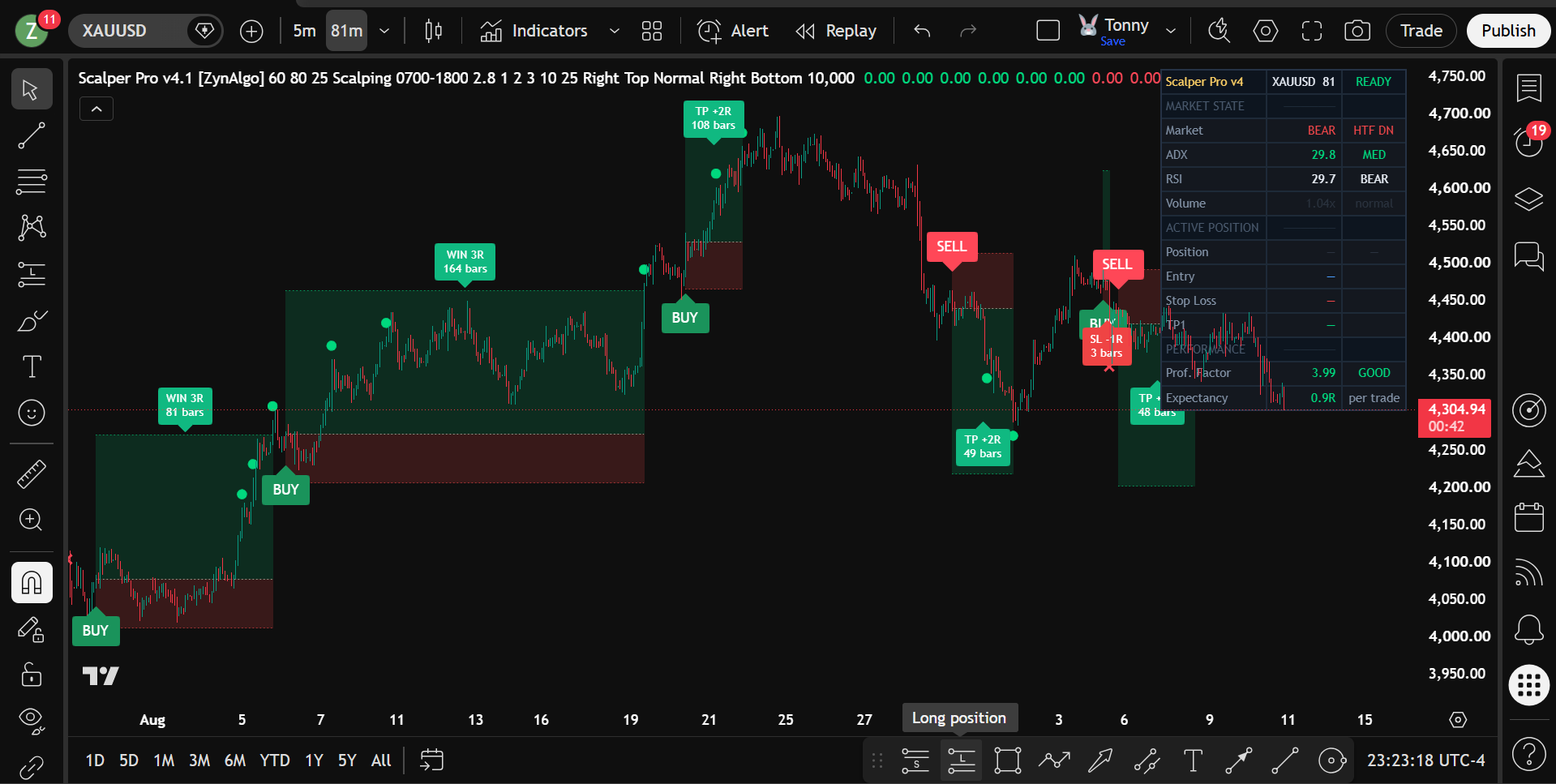
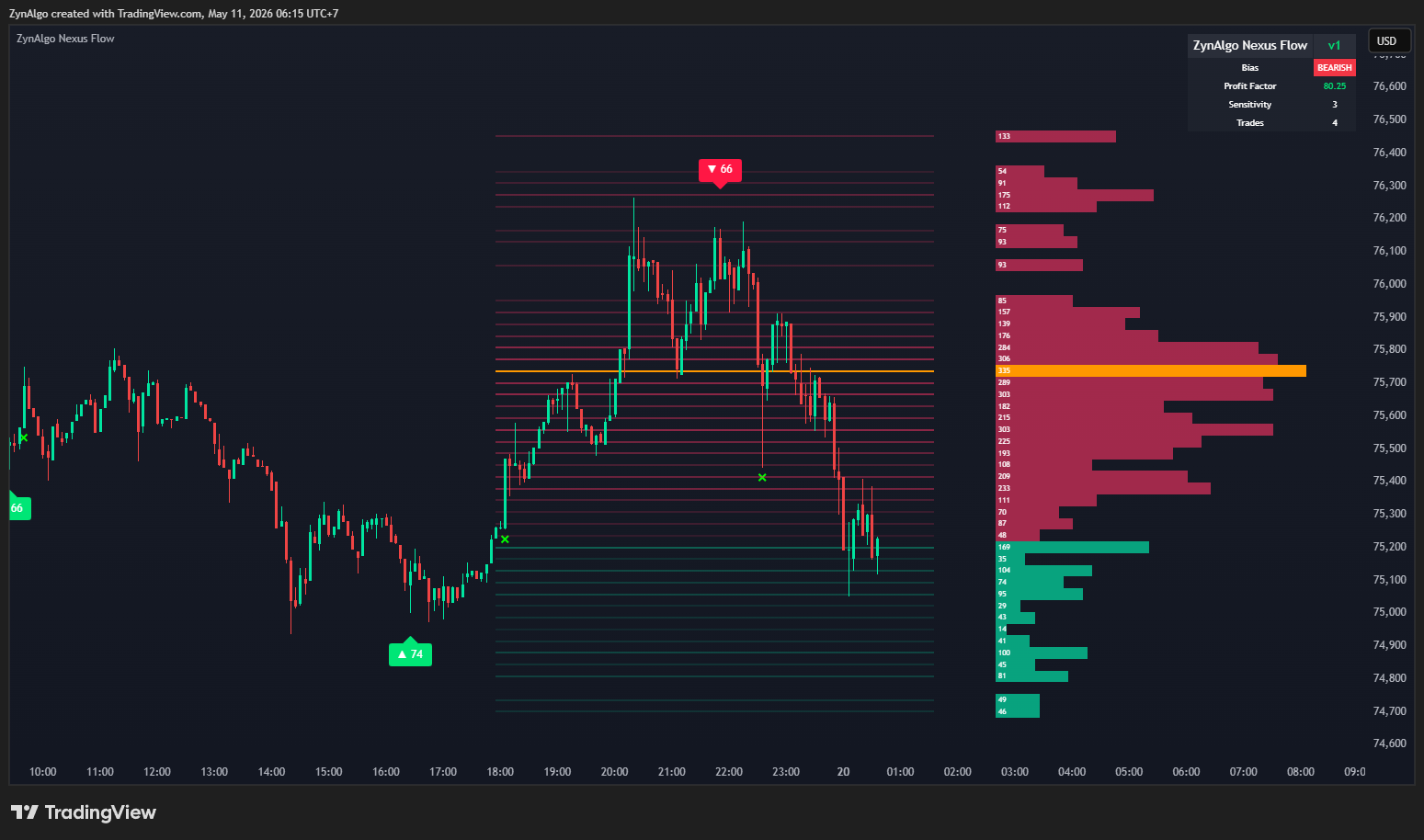
- a projected reward box (green) and risk box (red) draw on the chart from the entry, trimming to the level actually reached when the trade closes, with a centered WIN/SL label and a small dot or x marking each level hit along the way;
- an optional time filter restricts new entries to a fixed UTC window (HHMM-HHMM) you set, regardless of your chart or broker timezone; a trade already open still closes normally on TP/SL/timeout;
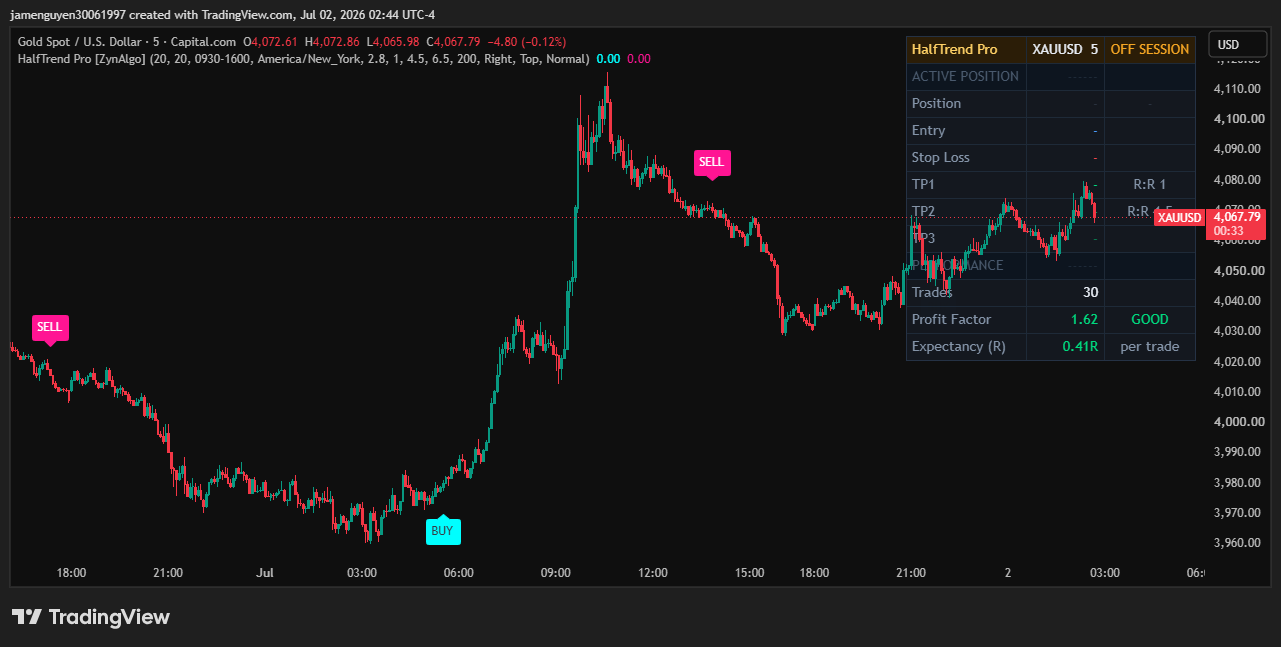
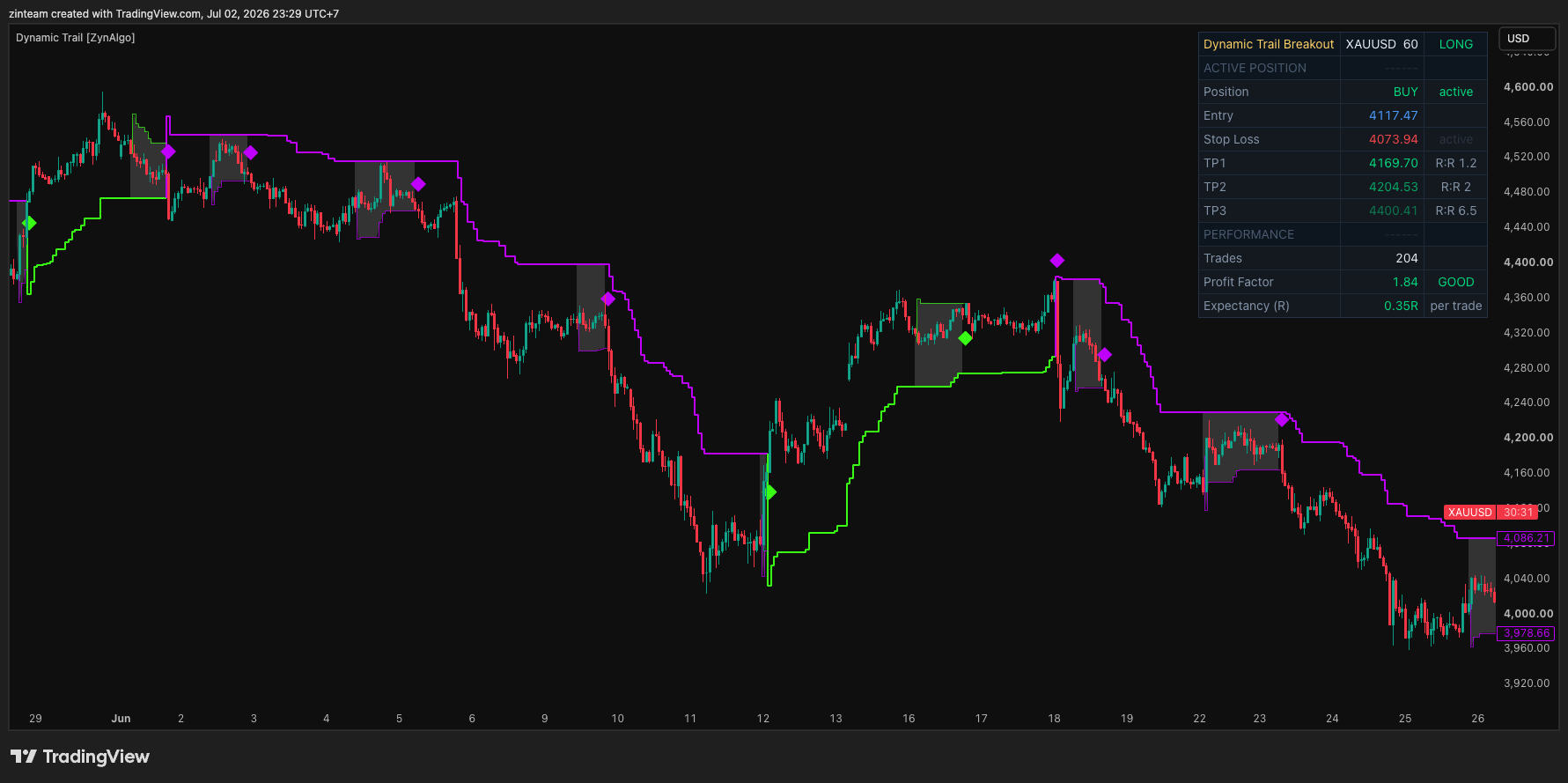
- the dashboard tracks the running position and its state, plus Trades, Win Rate, Profit Factor and Expectancy (R) so you can see how the settings have behaved on this market and timeframe.
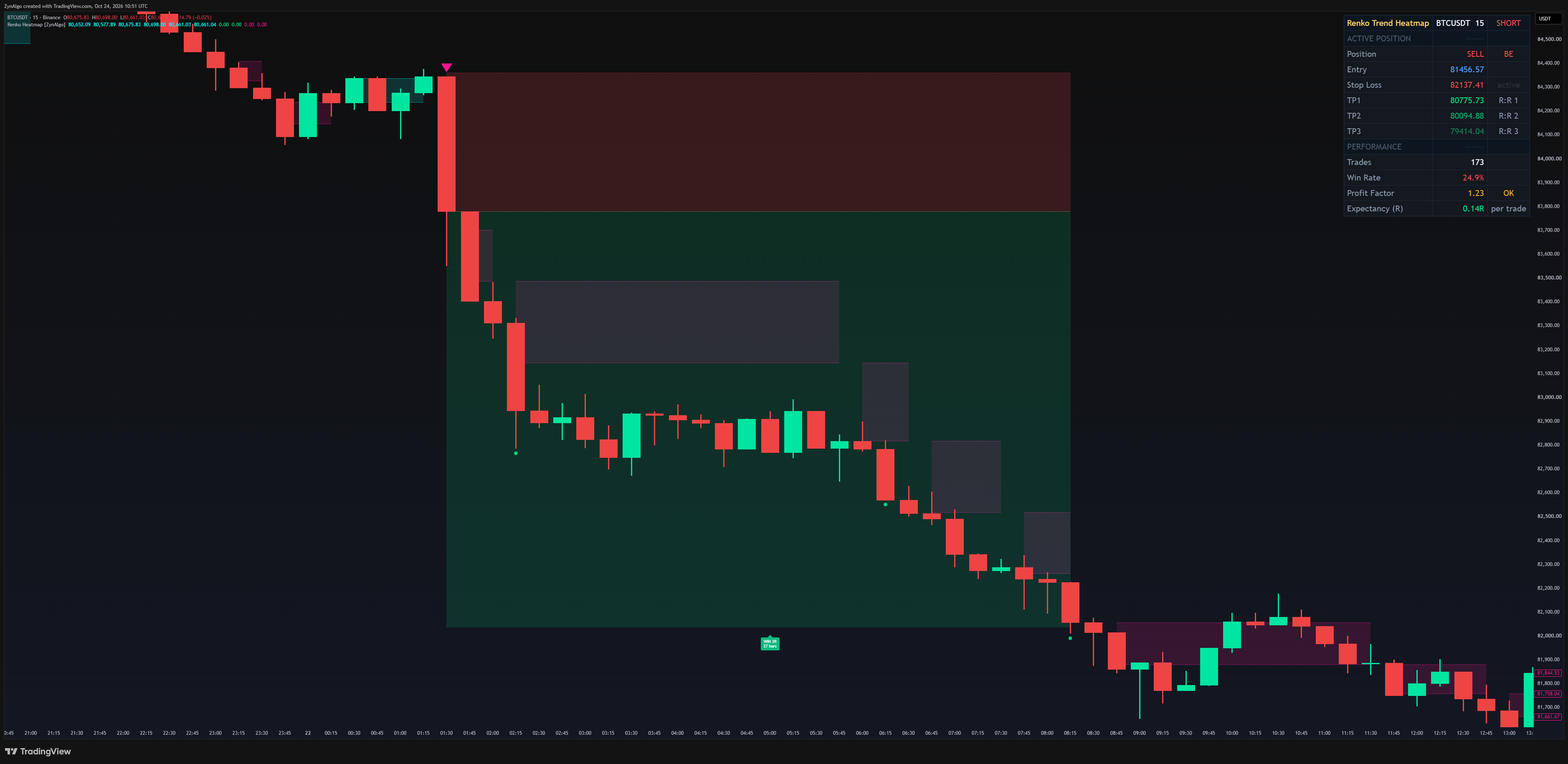
The dashboard header tells you the state before you act - READY when flat and in session, LONG or SHORT while a position is tracked, and OFF SESSION when the time filter has stood the tool down. Read that first: the levels below it only mean something while a trade is actually open.
Who Renko Trend Heatmap fits
- Trend followers: you want the direction and its strength on one clean overlay, without a fixed brick size that misreads half your sessions.
- Reversal traders: you trade the turn, and you want it filtered by volume so you are not first into every thin flip.
- Structure-based sizers: you frame risk from the setup, and want the stop distance and targets measured for you before you commit.
- Intraday and session traders: the session window keeps new entries inside the hours you actually trade.
A trend that colours deep and turns on heavy volume deserves more attention than a pale one that drifts across the line. The heatmap is the context; the volume-confirmed flip is the trigger.
Browse the ZynAlgo marketplace
Risk note: Renko Trend Heatmap [ZynAlgo] is a charting and signal tool, not a guarantee of results. Signals, heatmap colouring, projected levels and tracked statistics are analytical references only, and past behaviour does not predict future performance - always trade with your own plan and risk management.
No release notes have been published yet.