NR Engine
Quiet markets are where the next move is built. NR Engine [ZynAlgo] hunts the tightest coils on your chart - the NR4 and NR7 narrow-range bars where volatility has squeezed to a minimum - then marks the break that releases the pressure. Instead of guessing when a range is about to give way, you get a clean box, a boundary, and a single BUY or SELL marker when price commits.
Key benefits
- Coil detection built in: the engine scans a higher timeframe for NR4 and NR7 compression and frames each qualifying range on your chart.
- Breaks you can trust: every signal passes a macro trend filter and an anti-chop retest check before an arrow prints.
- One clear call per break: a cyan up-arrow or a pink down-arrow marks the confirmed structural breakout, so you always know the intended direction.
How it works
NR Engine measures each bar's range against the previous 4 and 7 bars on your chosen analysis timeframe and flags the narrowest as a compression zone. It draws the range with a ceiling, a floor and a median line, then waits for a close beyond the boundary that agrees with the macro trend. An optional retest filter holds the signal until price re-tags the edge and continues, filtering sideways noise. Full walkthrough in the Manual.
What's included / Platforms
- TradingView indicator, Pine Script v6, added to your TradingView username once access is granted. Released to ZynAlgo VIP members.
Best for
Breakout and momentum traders who want to trade the expansion out of low-volatility coils, with the pattern detection and the entry timing handled for them.
Get started
Browse the ZynAlgo marketplace
Disclaimer: not financial advice or a guaranteed signal service. Breakout signals can fail and no indicator removes market risk - trade with your own plan and position sizing.
NR Engine
What NR Engine does on your chart
NR Engine [ZynAlgo] does one job: it finds where volatility has compressed to a coil and marks the break that releases it. It scans your chosen analysis timeframe for the two classic narrow-range patterns - NR4 and NR7 - frames the qualifying range, and prints a single BUY or SELL marker when price closes through the boundary with confirmation behind it. It is a signal tool: it tells you the direction and the moment of the break, so you are trading the expansion rather than chasing it.
The philosophy is simple. The market alternates between contraction and expansion. When a bar prints the narrowest range of the last 4 or 7 bars, the crowd has gone quiet and stops are stacking on both sides of a tight box. The move that breaks that box tends to travel, because it is the release of pressure that has been building. NR Engine automates the two hard parts: spotting the coil the moment it forms, and staying patient until the break actually commits.
The narrow-range coil
The core concept is the narrow-range coil: a bar whose high-to-low range is the smallest of its recent lookback, drawn on the chart as a boundary box you can trade against. A tight bar on its own is easy to miss and easy to misjudge. Framed as a range with a defined ceiling, floor and median, it becomes a level structure with two clear edges - and a break of either edge becomes a decision you can act on.
Why it matters: without the box, a breakout is just a candle poking out of a cluster. With the box, you know exactly which price is the trigger, which side the macro trend favours, and where the retest should hold. That is the difference between a guess and a plan.
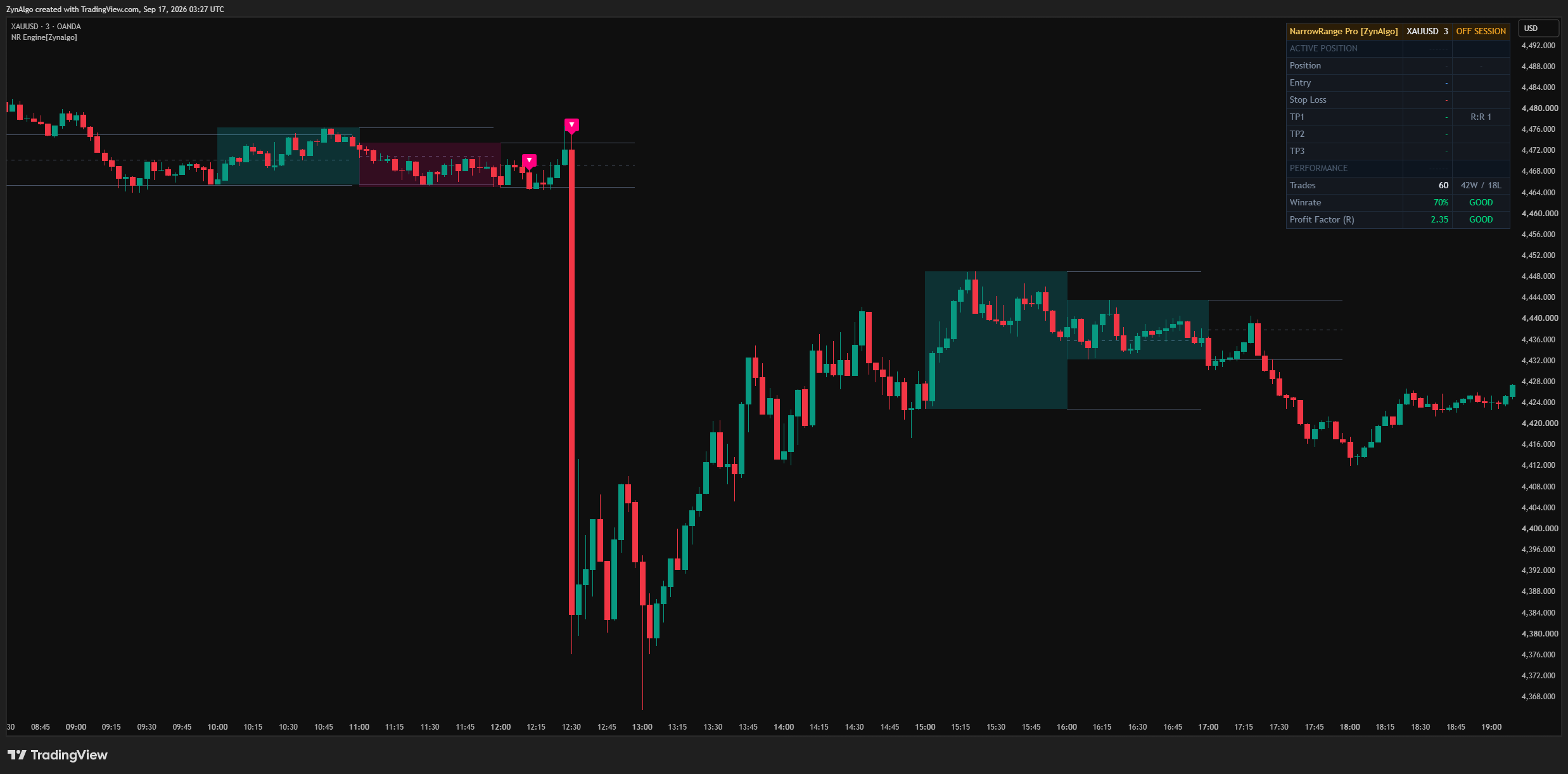
What a live coil looks like on the chart:
- a shaded box spanning the high and low of the qualifying narrow-range bar, coloured by pattern - cyan shading for NR4, pink for NR7;
- a solid ceiling line at the range high and a solid floor line at the range low;
- a dashed median line at the midpoint of the range;
- the box and its lines extending to the right until a break resolves the range.
Common mistake: treating every tight bar as a trade. A coil is only a setup once price breaks its edge in agreement with the macro trend - the box is the context, not the entry.
How the narrow-range coil is defined
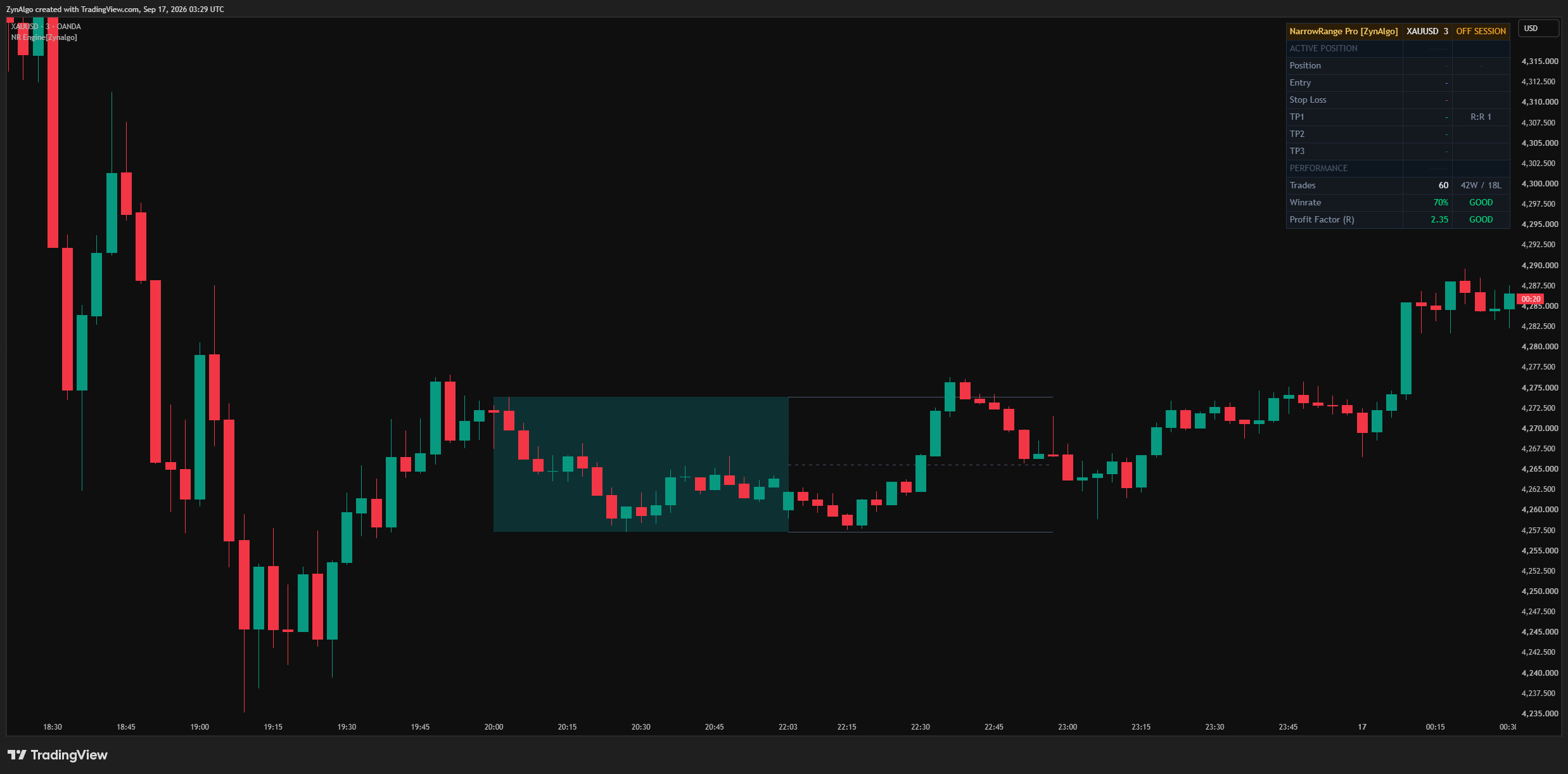
- Volatility scanner: each bar's range is compared with the lowest range of the last 4 bars (NR4) and the last 7 bars (NR7) on your Analysis Timeframe. You choose NR4/NR7 Dual, NR4 Only, or NR7 Only. When both qualify, NR7 takes priority as the tighter, rarer coil.
- Range box: the qualifying bar's high and low become the ceiling and floor, and their average becomes the median. These three levels are the framework every break is measured against.
- Macro trend filter: an EMA of your chosen length (default 200) defines the higher-order trend. When active, only breaks that agree with it are allowed - up-breaks require price above the EMA, down-breaks require price below it.
- Retest verification (anti-chop): an optional filter that holds a raw break for a set number of bars and only confirms it once price re-tags the boundary edge and continues in the break direction, removing the sawtooth false breaks of choppy markets.
- Signal marker: once a break is confirmed, a cyan up-arrow (below the bar) or a pink down-arrow (above the bar) is printed.
How to trade the break
NR Engine gives you a direction and a moment, not a full trade plan - the stop, target and size stay with you. The signal fires only when the sequence below completes, which is what keeps it selective.
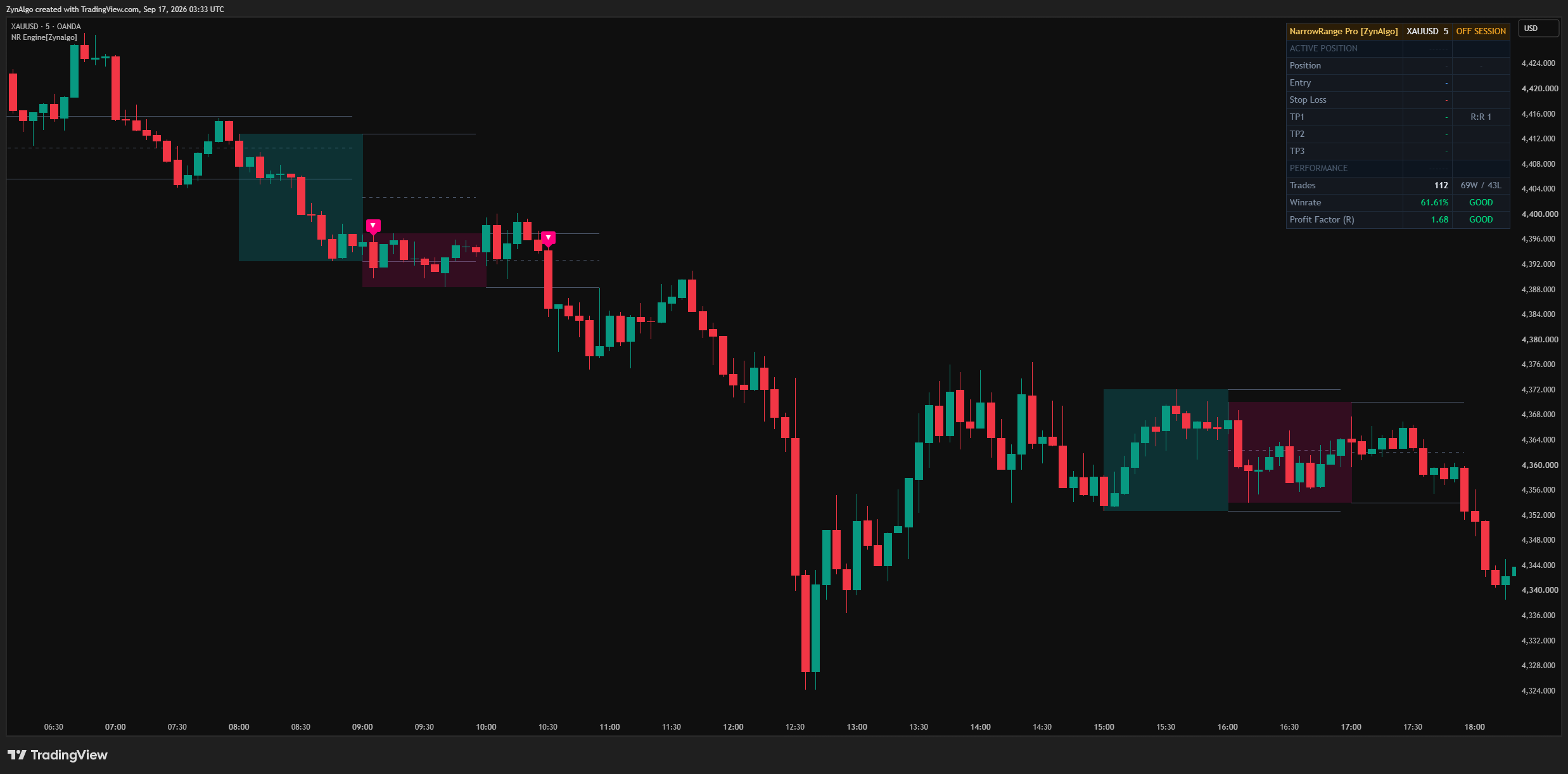
The rules a signal has to pass before it prints:
- Coil in place - the current range qualifies as NR4 or NR7 on the analysis timeframe, so a boundary box exists.
- Boundary break - price closes above the ceiling for a long, or below the floor for a short. A reset gate makes sure price has first pulled back through the median, so you are trading a genuine break of the range and not a bar that was already outside it.
- Trend agreement - with the macro filter on, the break must align with the EMA trend, so you are not fading the higher-order direction.
- Retest holds - with the anti-chop filter on, price must return to tag the broken edge and then continue, confirming the break has support.
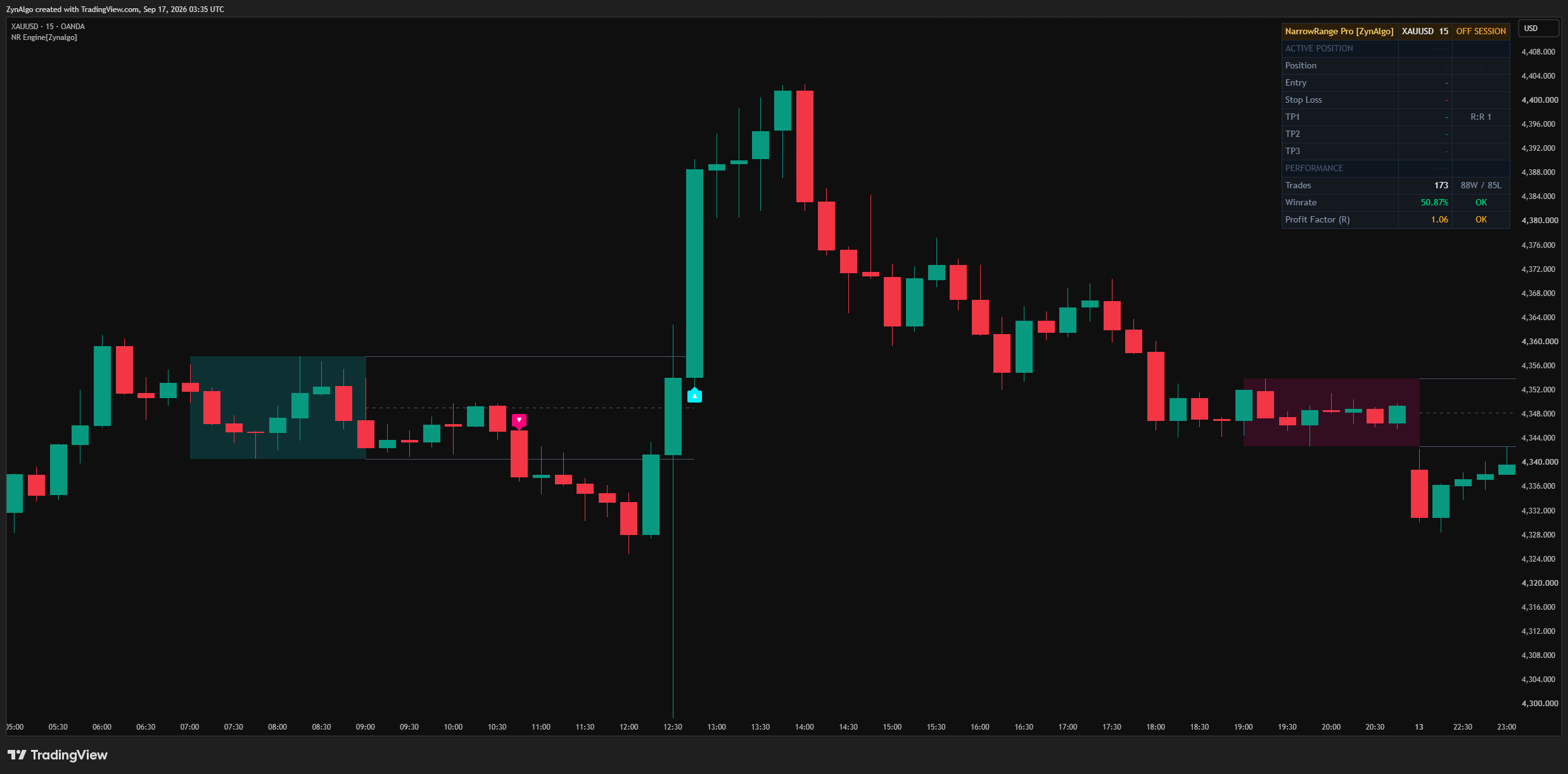
How to read the marker in practice:
- a cyan up-arrow means an NR coil broke to the upside with trend and retest confirmation - the intended play is a long in the break direction;
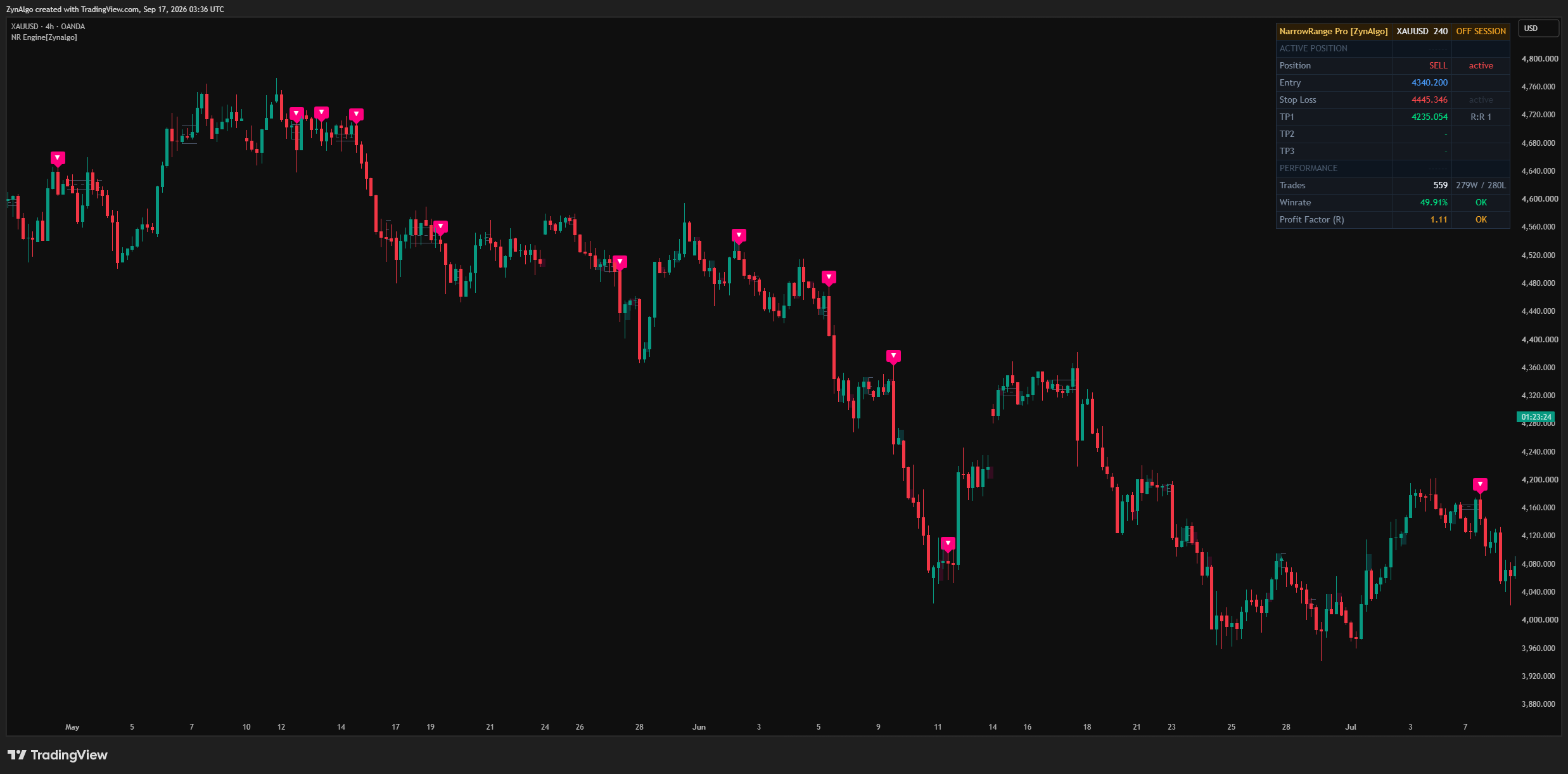
- a pink down-arrow means the coil broke down under the same conditions - the intended play is a short;
- the median line is your invalidation reference: a break that snaps back through the median has failed its premise, whatever your stop rule;
- if you prefer to see fewer, cleaner breaks, keep the retest filter on; if you want the earliest possible entry, turn it off and take the raw boundary break.
Who NR Engine is for
- Breakout traders: you want to be positioned the moment a coil expands, and you want the coil found for you rather than eyeballed.
- Swing traders on the daily coil: the default analysis timeframe frames NR4/NR7 setups on higher timeframes, giving you a handful of high-quality breaks to work rather than constant noise.
- Momentum traders who hate chop: the trend filter and retest check exist precisely to keep you out of the sideways markets where breakout systems bleed.
- Discretionary traders who want structure: the box, the median and the marker give you a repeatable framework to build your own entries and stops around.
A breakout signal is a starting point, never a promise. The value is in trading the coils that clear every filter and passing on the ones that do not, then managing the trade with your own risk rules.
Browse the ZynAlgo marketplace
Risk note: NR Engine [ZynAlgo] identifies breakout signals but does not place trades or guarantee outcomes. Breakouts can fail and reverse - always use your own stop, target and position sizing.
No release notes have been published yet.