
VP MACD Intraday Pulse
Classic MACD is late and noisy in sideways markets. VP MACD Intraday Pulse rebuilds it on MetaTrader 4 by weighting momentum with tick-volume participation and normalising by local volatility, so crossovers adapt to the session instead of lagging it.
Key benefits
- Volume-weighted momentum - the MACD engine is weighted by tick-volume participation, so a cross backed by activity is treated differently from a quiet drift
- Volatility-normalised - the histogram is measured in ATR units, so the same reading means the same thing across instruments
- Two tiers plus an early pulse - a regular cross, a strong tier with histogram slope and range position, and an early histogram-zero pulse to keep frequency practical
- Risk already measured - stop beyond the signal candle plus 0.25 ATR, targets at 0.9R and 1.5R
How it works
The VP-MACD line crosses its signal while the histogram is contained, tick-volume ratio is above 0.85 of its average, and price is on the correct side of the 48-bar intraday midpoint - a BUY on the closed candle. The strong tier adds histogram slope and range position. Shorts mirror it. Full rule set is in the Manual.
What's included
MetaTrader 4 indicator file (.ex4), with fast/slow volume-weighted EMA lengths, signal length, ATR normalisation, midpoint length and volume threshold open in the Inputs tab.
Best for
Intraday momentum traders on indices M1-M5, gold M5-M15 and forex majors M5-M15 who want MACD entries that respond to volume and volatility.
Get access
-> Browse the ZynAlgo marketplace
Trading involves risk. This indicator is an analysis tool for educational purposes and does not guarantee results.
VP MACD Intraday Pulse
What has to line up before a signal can print
VP MACD Intraday Pulse is a volume-weighted MACD signal indicator for MetaTrader 4. It takes the familiar MACD cross and makes it condition-aware: momentum is weighted by tick-volume participation and normalised by local volatility, so the same cross is judged against the session it happens in.
Every closed candle is measured against:
- VP-MACD cross - a volume-weighted MACD line crossing its signal line
- Histogram in ATR units - the histogram normalised by ATR, so extremes and slope are comparable across instruments
- Participation - tick-volume ratio against its 20-bar average
- Intraday position - price relative to the rolling 48-bar midpoint
- Context filters - ATR floor, volume floor, spread cap and histogram maturity
Only when the cross, the volume and the midpoint position agree does a BUY or SELL arrive.
Why weighting MACD by volume changes the signal
Standard MACD treats every cross the same. VP MACD Intraday Pulse does not, because a cross on thin participation in the middle of a range is the exact signal that produces whipsaws.
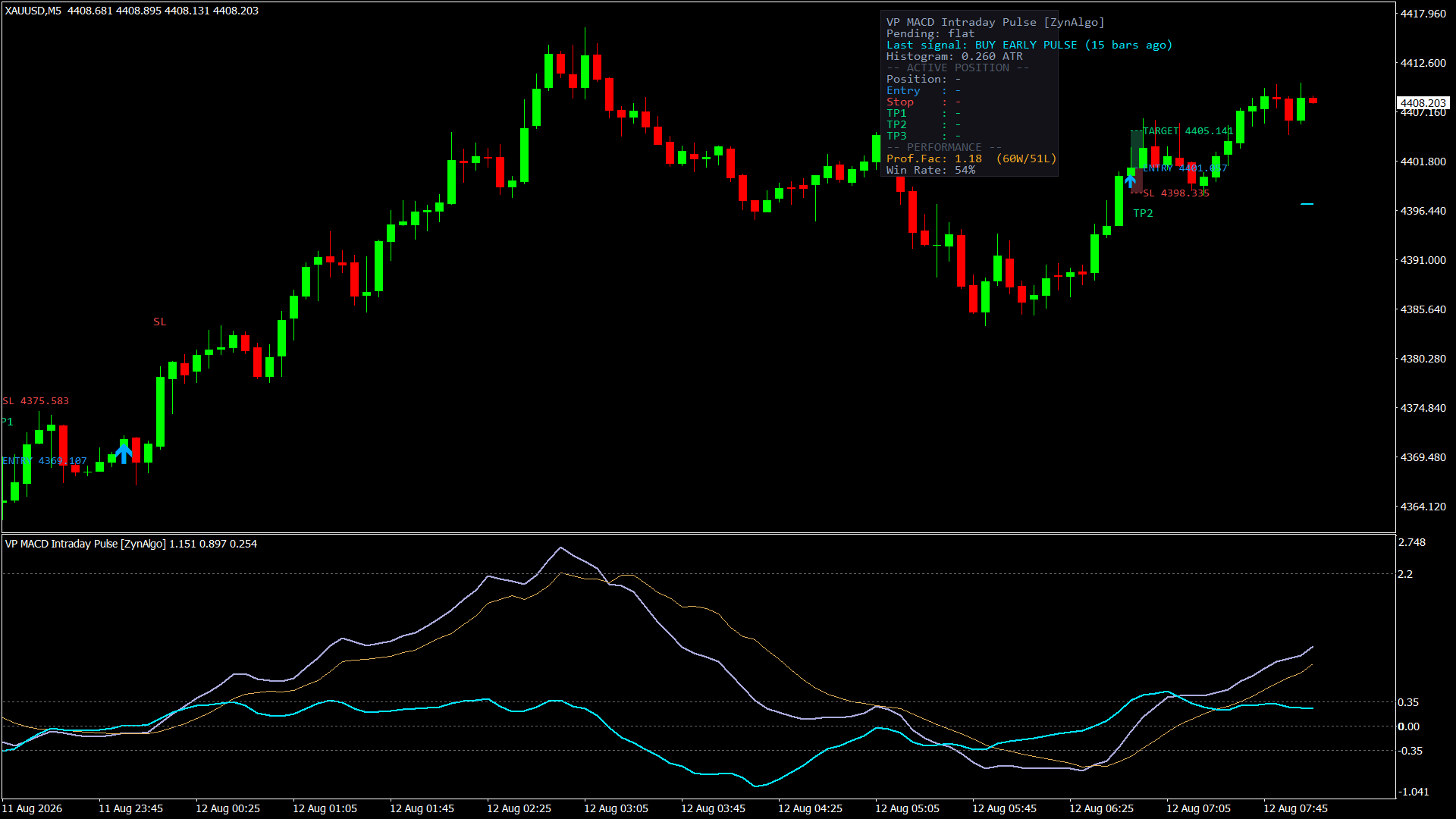
- The oscillator shows the VP-MACD and signal lines with an ATR-normalised histogram
- The rolling midpoint on the price chart marks the intraday context the signal is checked against
- The mistake this avoids is trading a low-volume MACD cross - the volume ratio gate holds those back
How the signal and tiers are defined
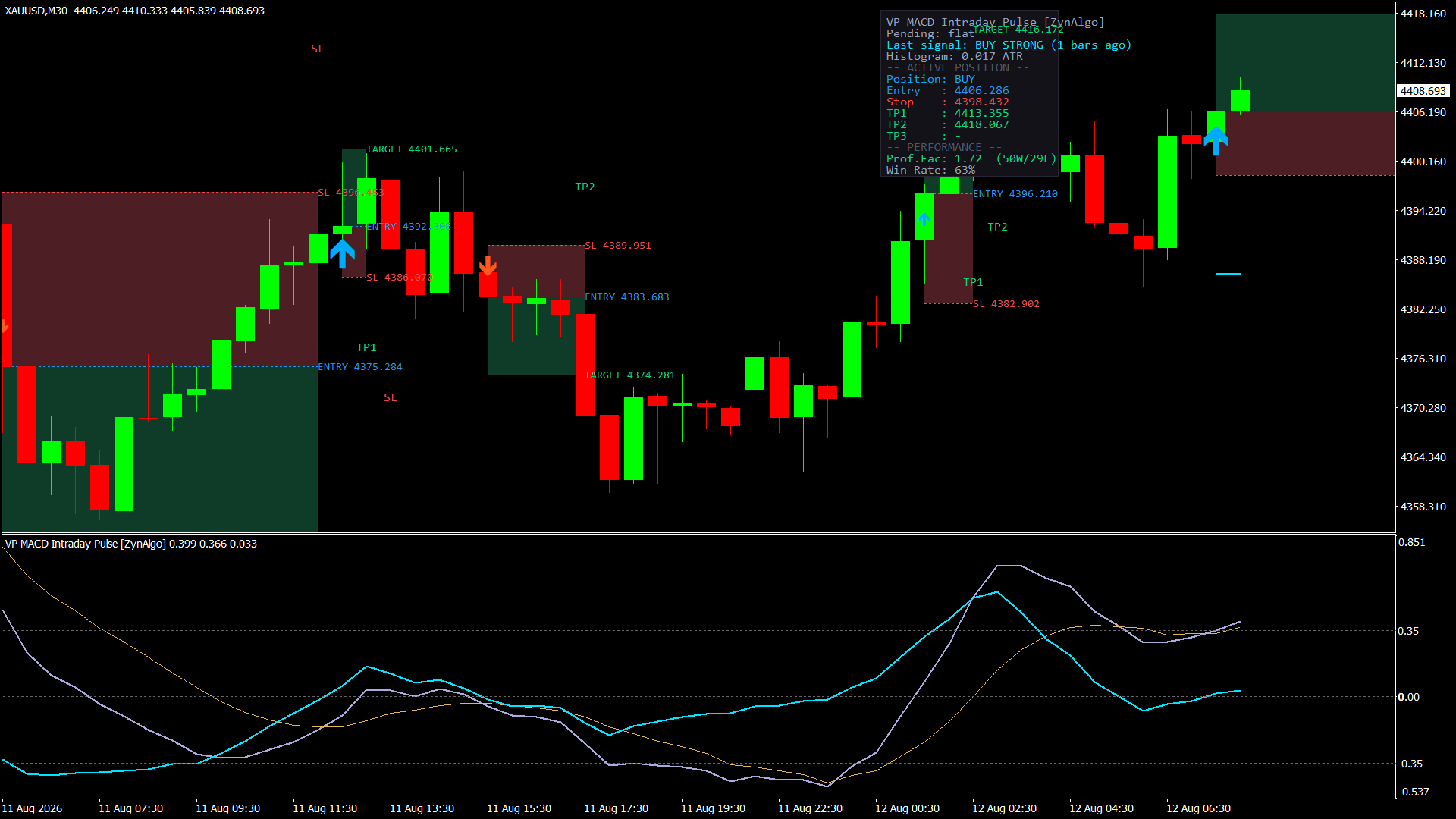
- Regular - the VP-MACD line crosses its signal while the histogram is inside +/-0.35 normalised ATR units, tick-volume ratio is above 0.85 of its 20-bar average, and close is on the correct side of the 48-bar midpoint
- Strong - the regular conditions plus histogram slope in the trade direction for 2 bars and close in the outer 60/40% of the 48-bar range
- Early pulse - to keep frequency practical, a pulse may fire when the histogram crosses zero with all filters aligned even if the formal line cross happened within the last 4 bars
- Maturity block - a histogram beyond 2.2 ATR-normalised units after a mature impulse is rejected as late
From cross to signal: reading an arrow
Signals are evaluated on closed candles only.
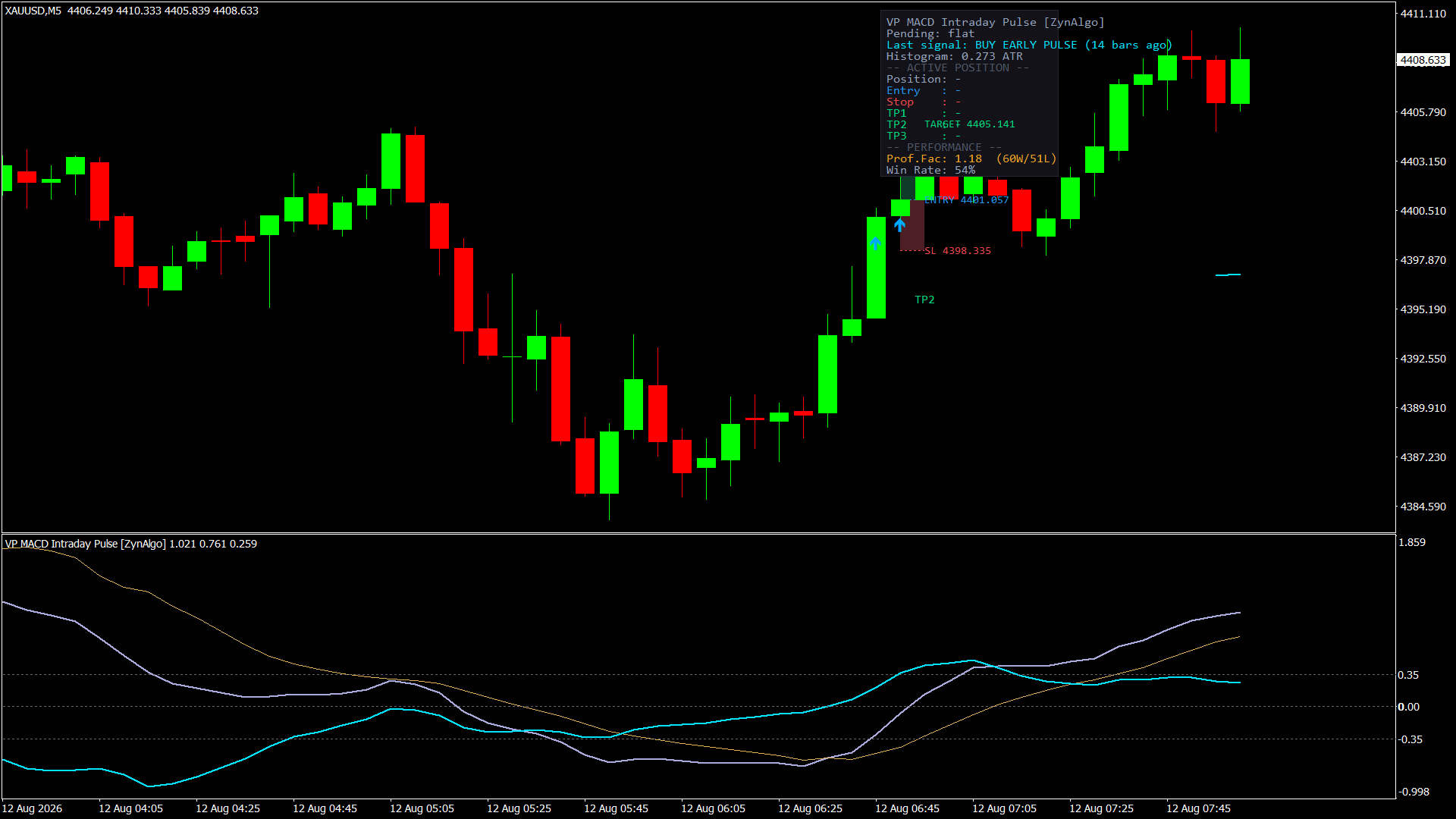
A BUY prints when:
- The VP-MACD line crosses above its signal while the histogram is below +0.35 normalised ATR units
- Tick-volume ratio is above 0.85 of its 20-bar average
- Close is above the 48-bar rolling midpoint
- ATR, volume, spread and maturity filters allow the bar; the strong tier adds positive histogram slope and upper-range position
A SELL is the mirror image: a cross below the signal with the histogram above -0.35 units, the same volume gate, close below the midpoint, and a negative slope with lower-range position for the strong tier.
What appears on the chart:
- The oscillator histogram, the VP-MACD and signal lines, a zero/midline band and the rolling midpoint line, plus price-chart pulse arrows
- A BUY or SELL arrow with entry at the signal close, a stop beyond the signal candle extreme plus 0.25 ATR, TP1 at 0.9R and TP2 at 1.5R, with an optional exit on the opposite cross or midpoint loss
- Alerts for regular and strong signals, the early pulse, volume and midpoint blocks, opposite-cross exit and TP/SL updates
Is VP MACD Intraday Pulse right for you?
It fits you if:
- You trade intraday momentum and use MACD but dislike its lag and noise in ranges
- You want crossovers weighted by participation and normalised by volatility
- You would rather have the stop and targets attached to the signal
- You work on indices M1-M5, gold M5-M15 or forex majors M5-M15
It fits you less well if you want a signal on every cross. Broker tick-volume quality varies and volume weighting can overstate noisy sessions, so the volume and volatility filters are there to keep it honest. The intraday midpoint is a local context filter, not an external benchmark, and no profitability is implied.
Installing it: copy the .ex4 file into the MQL4/Indicators folder inside your terminal's data folder, refresh the Navigator panel in MetaTrader 4, then drag VP MACD Intraday Pulse onto the chart. Every threshold above is editable in the Inputs tab.
-> Browse the ZynAlgo marketplace
This indicator is provided for educational purposes only and does not constitute financial advice. Trading involves risk; past performance does not guarantee future results.
- v1Jul 22, 2026
Initial release

Why Low-Volume MACD Crosses Keep Whipsawing Your Intraday Entries
Standard MACD treats every cross the same, but a cross on thin participation in the middle of a range is the exact signal that produces whipsaws. VP MACD Intraday Pulse weighs each cross by tick-volume participation and normalises the histogram by ATR.

Why MACD crossovers keep whipsawing you in low-volume sessions
Standard MACD treats every cross the same. VP MACD Intraday Pulse weights the cross by tick-volume participation and normalizes the histogram by ATR, so the same signal is judged against the session it happens in.