
Entropy Expansion Pulse
Most breakout tools fire in the chop right before the move. Entropy Expansion Pulse measures whether the recent bar sequence is random or structured on MetaTrader 4, and only accepts a momentum signal once noisy compression turns into a real directional expansion.
Key benefits
- A regime read, not just a cross - rolling entropy classifies the market as chaotic, transitional or trending before any signal is allowed
- Expansion-confirmed - a signal needs ATR rising above its average and a genuine breakout close, not a drift
- Two tiers - a regular signal plus a strong tier that adds EMA slope and an adaptive entropy baseline
- Risk already measured - stop behind the breakout bar's opposite extreme plus 0.25 ATR, targets at 1.0R and 1.6R
How it works
Entropy has to leave the chaotic zone, ATR(14) has to rise above its 20-bar average, and price has to break the highest close of the last 6 bars with the body closing in the upper 35% of the bar - then a BUY prints on the closed candle. The strong tier adds a positive EMA(21) slope. Shorts mirror it. Full rule set is in the Manual.
What's included
MetaTrader 4 indicator file (.ex4), with fast/slow entropy windows, regime thresholds, ATR length, breakout lookback, EMA baseline and cooldown open in the Inputs tab.
Best for
Intraday breakout traders on gold M5-M15, indices M1-M5 and forex majors M5-M15 who want a filter that stays out of the chop and only acts on real expansion.
Get access
-> Browse the ZynAlgo marketplace
Trading involves risk. This indicator is an analysis tool for educational purposes and does not guarantee results.
Entropy Expansion Pulse
What has to line up before a signal can print
Entropy Expansion Pulse is a regime-filtered breakout indicator for MetaTrader 4. Its job is to keep you out of the noise: it measures how random the recent bar sequence is, and only lets a momentum signal through once that structure resolves into a directional expansion.
Every closed candle is measured against:
- Entropy regime - fast and slow rolling entropy classifying the market as chaotic, transitional or trending
- Expansion - ATR(14) rising above its 20-bar average, confirming volatility is actually opening up
- Breakout - close beyond the highest or lowest close of the last 6 bars, with the body in the upper or lower 35% of the bar
- Strength - EMA(21) slope and an adaptive entropy baseline separating a strong signal from a regular one
- Context filters - spread cap, minimum bar range, cooldown and an optional higher-timeframe regime check
Only when entropy has left the chaotic zone and expansion confirms does a BUY or SELL arrive.
Reading the entropy regime
Most breakout tools have no idea whether the market is trending or just noisy. Entropy Expansion Pulse measures exactly that, because the same breakout candle means very different things in chaos and in structure.
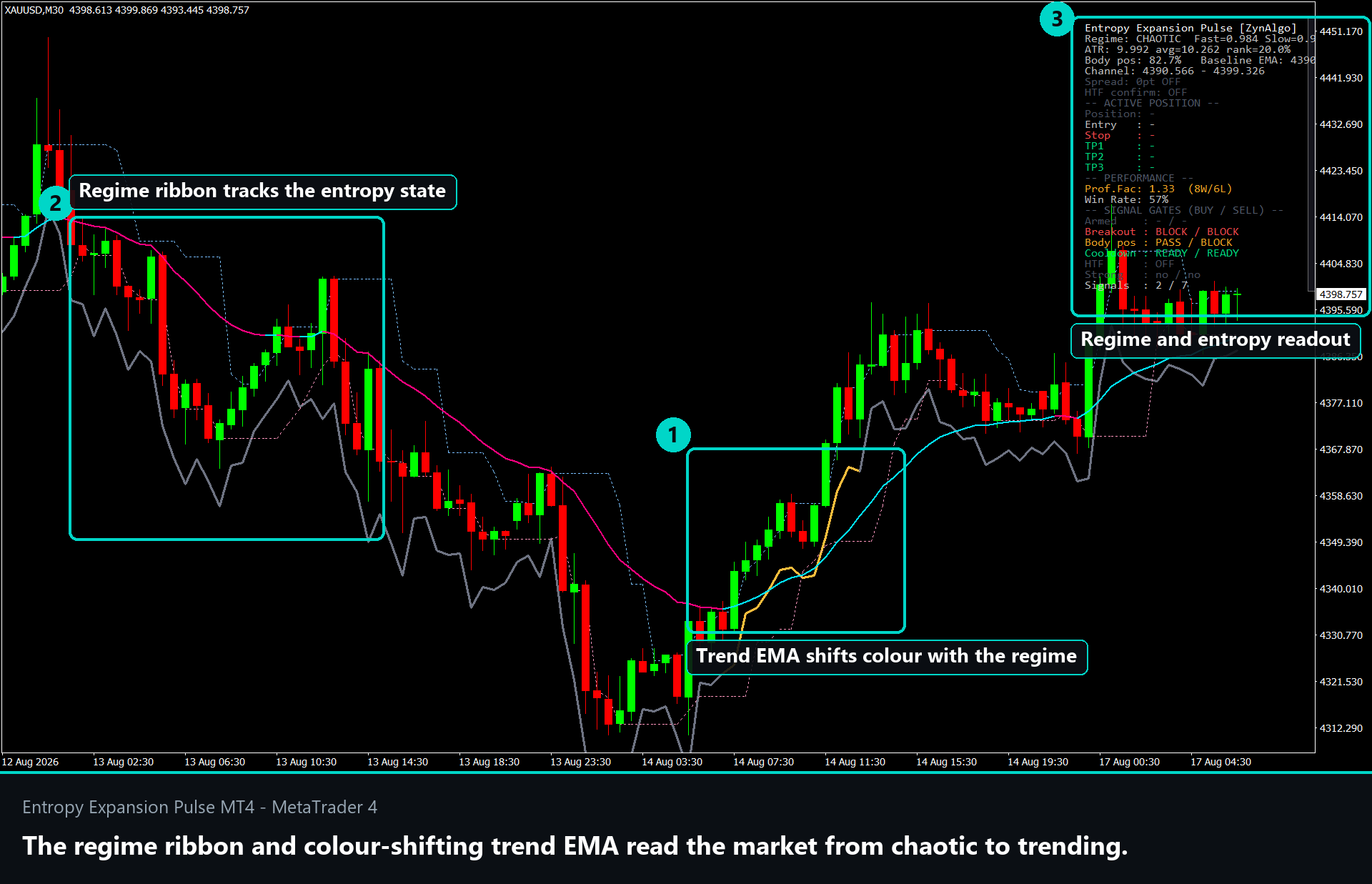
- The regime ribbon colours every bar by state - chaotic, transitional or trending
- The adaptive baseline tracks the structured direction once entropy cools out of chaos
- The mistake this avoids is taking a breakout while the sequence is still random - the setup only arms once entropy leaves the chaotic threshold
How the regime and breakout are defined
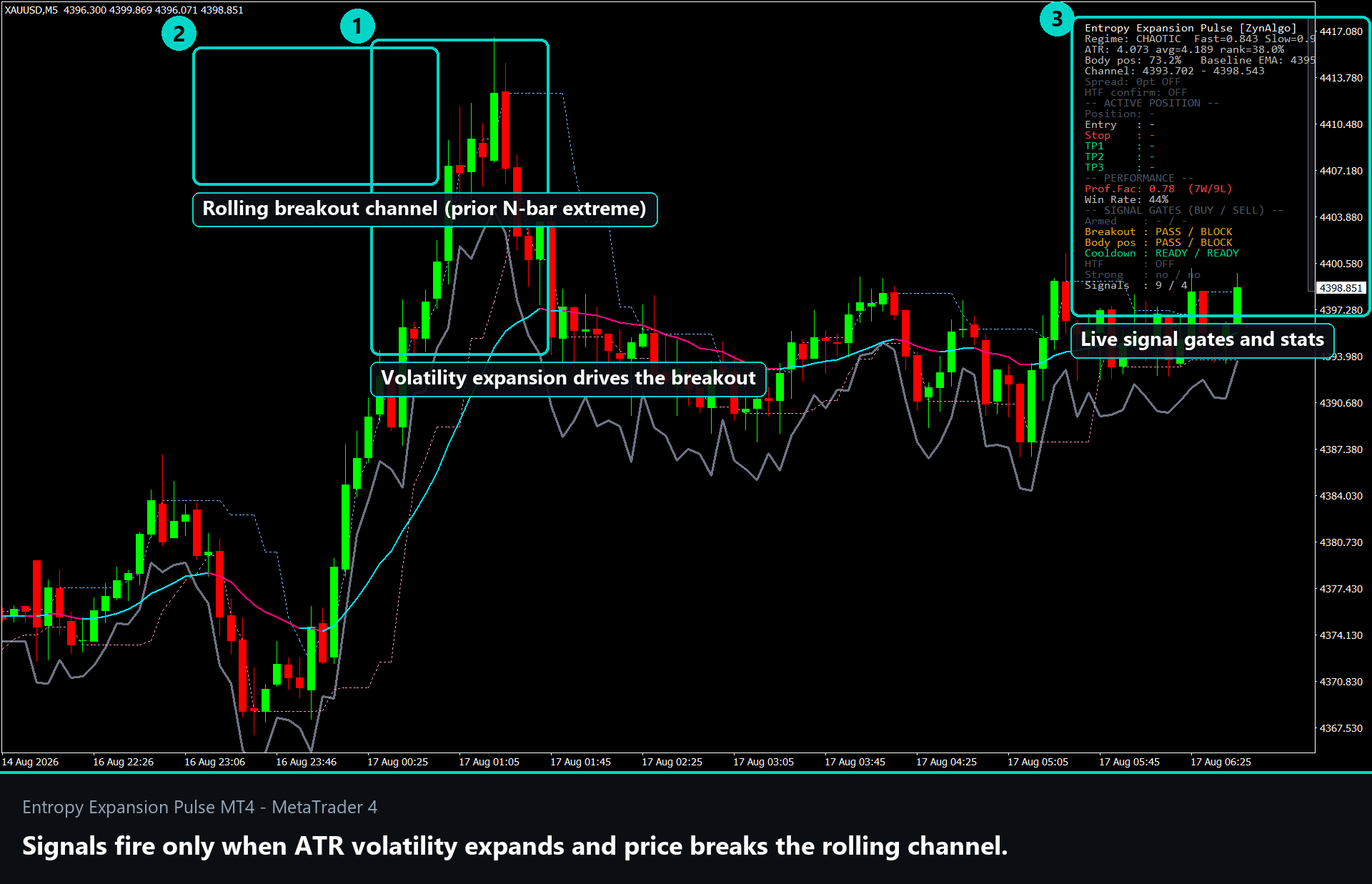
- Entropy - a fast window (20) against a slow window (80); the signal arms when fast entropy crosses below slow or drops under the trend threshold (0.38)
- Chaotic threshold - while entropy is above the chaotic level (0.66) no signal is allowed; the setup arms for 5 bars after it leaves that zone
- Expansion - ATR(14) rising above its 20-bar average confirms the move has volatility behind it
- Breakout body - the candle has to break the 6-bar close extreme and close in the outer 35% of its own range
From armed to fired: reading a signal
Signals are evaluated on closed candles only, and an opposite signal fewer than 3 bars old is blocked.
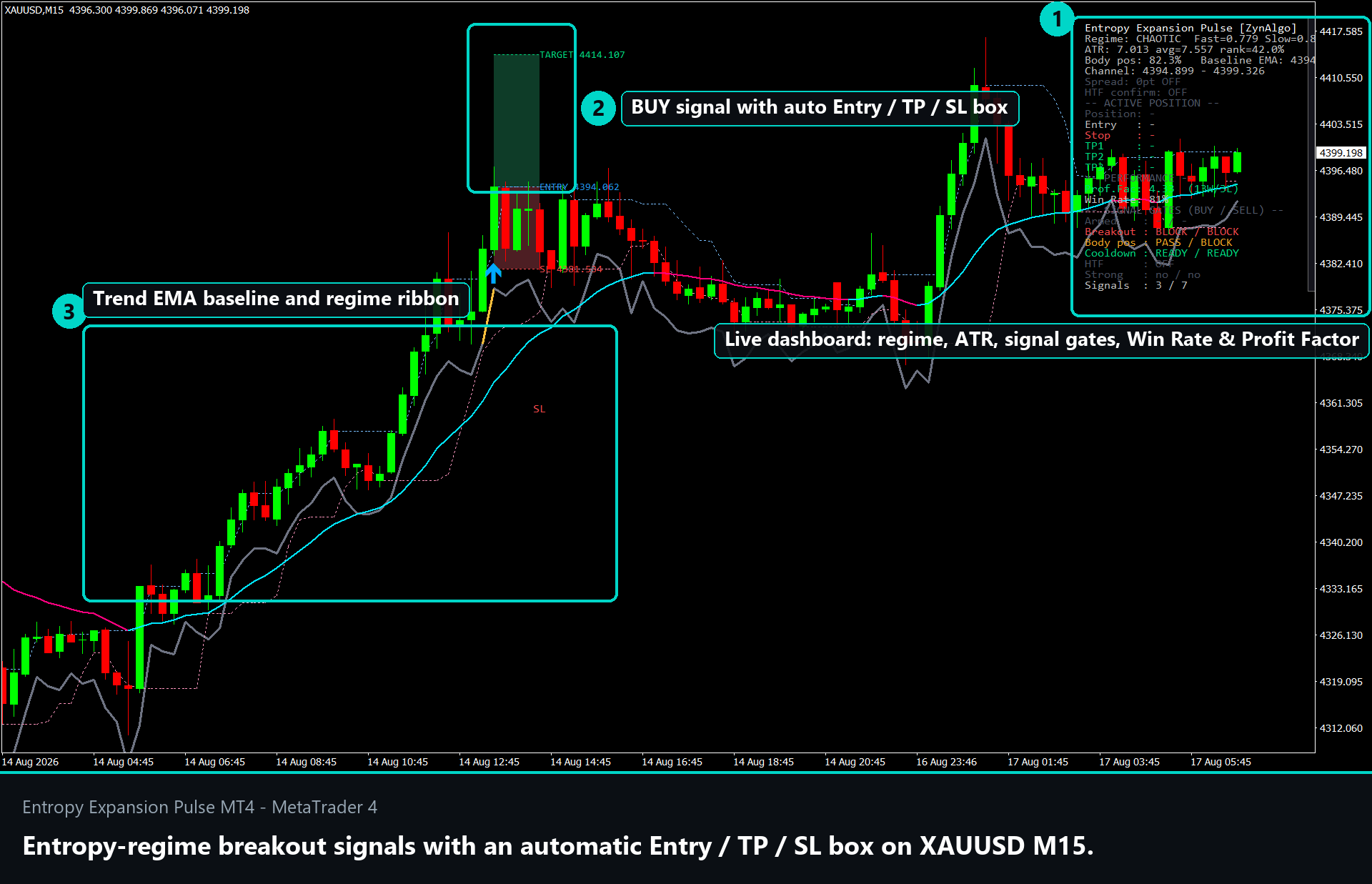
A BUY prints when:
- Entropy has left the chaotic zone and crossed below slow entropy or under the trend threshold
- ATR(14) is above its 20-bar average
- Close breaks above the highest close of the last 6 bars, with the body in the upper 35% of the bar
- Spread, range and cooldown filters allow the bar; the strong tier adds a positive EMA(21) slope and close above the adaptive baseline
A SELL is the mirror image: the same entropy and expansion conditions with a break below the 6-bar low close and the body in the lower 35%, plus a negative EMA slope for the strong tier.
What appears on the chart:
- The entropy regime ribbon, the adaptive baseline coloured by regime, breakout markers and setup-countdown dots
- A BUY or SELL arrow with entry at the breakout close, a stop behind the breakout bar's opposite extreme plus 0.25 ATR, TP1 at 1.0R, TP2 at 1.6R and an optional baseline/EMA trail
- Alerts for setup armed, regular and strong signals, opposite exit, TP hits, and entropy returning to chaotic while a trade is active
Is Entropy Expansion Pulse right for you?
It fits you if:
- You trade intraday breakouts and keep getting chopped up before the real move
- You want a regime filter that measures structure rather than guessing
- You would rather have the stop and targets attached to the signal
- You work on gold M5-M15, indices M1-M5 or forex majors M5-M15
It fits you less well if you want a signal on every push. Entropy classifies structure, not direction, so it can still trigger late after very fast news candles and can whipsaw in alternating chop. It makes no claim of predictive certainty.
Installing it: copy the .ex4 file into the MQL4/Indicators folder inside your terminal's data folder, refresh the Navigator panel in MetaTrader 4, then drag Entropy Expansion Pulse onto the chart. Every threshold above is editable in the Inputs tab.
-> Browse the ZynAlgo marketplace
This indicator is provided for educational purposes only and does not constitute financial advice. Trading involves risk; past performance does not guarantee future results.
- v1Jul 22, 2026
Initial release

Why Breakout Signals Fire in Chaos and Fail Before the Real Move
Most breakout indicators cannot tell the difference between noise and structure. That single blind spot is why you get stopped out during chop and miss the expansion when it finally arrives.

Why Breakout Signals Fail in Choppy Markets and How Entropy Filters Help
Most breakout indicators trigger in noise because they cannot measure whether the market is random or structured. Entropy Expansion Pulse classifies the regime first, then only fires when expansion confirms the move.