
Wick Absorption Reversal Pulse
Everyone watches rejection wicks, but most wick tools ignore whether anyone was actually there. Wick Absorption Reversal Pulse scores a rejection candle on MetaTrader 5 with a tick-volume z-score and a follow-through check, so an absorbed wick at a level is a signal and a random wick is not.
Key benefits
- Wick plus participation - a signal needs a dominant wick and an elevated tick-volume z-score, not just a long tail
- Confirmed, not aggressive by default - follow-through through the rejection candle's extreme is required unless you switch on aggressive mode
- Zone-aware - the rejection has to sit at a recent support/resistance or swept-liquidity zone
- Risk already measured - stop beyond the wick extreme plus a buffer, targets at the nearest opposing swing and the prior range edge
How it works
A candle prints a lower wick at least the wick ratio times its body, tick-volume z-score is elevated, close returns above the wick midpoint, and price sits at support - then confirmation through the rejection high fires a BUY on the closed candle. Shorts mirror it at resistance. Full rule set is in the Manual.
What's included
MetaTrader 5 indicator file (.ex5), with wick/body ratio, minimum wick points, volume z-score lookback, support/resistance lookback, confirmation mode and EMA filter open in the Inputs tab.
Best for
Intraday and scalping traders on gold M1-M15, forex majors M5-H1 and indices M1-M5, best in active London and New York sessions, who trade rejection reversals at levels.
Get access
-> Browse the ZynAlgo marketplace
Trading involves risk. This indicator is an analysis tool for educational purposes and does not guarantee results.
Wick Absorption Reversal Pulse
What has to line up before a signal can print
Wick Absorption Reversal Pulse is a rejection-reversal signal indicator for MetaTrader 5. Its edge over a plain wick tool is participation: it only treats a rejection as absorption when the tick-volume behind it was abnormal, and it wants follow-through before it commits.
Every closed candle is measured against:
- Wick dominance - a lower or upper wick at least the wick ratio times the candle body, above a minimum wick size
- Participation - a tick-volume z-score that is elevated against its lookback
- Location - the candle sitting at a recent support/resistance or swept-liquidity zone
- Reclaim - close returning across the wick midpoint, in the upper half for a BUY or the lower half for a SELL
- Confirmation - next-bar follow-through through the rejection candle's extreme, unless aggressive mode is on
Only when the wick, the volume and the location agree, and follow-through confirms, does a BUY or SELL arrive.
Why a wick needs volume behind it
A long wick on its own says nothing about who was defending the level. Wick Absorption Reversal Pulse scores the wick with a tick-volume z-score, because absorption is the difference between a level that held on real activity and one that just drifted.
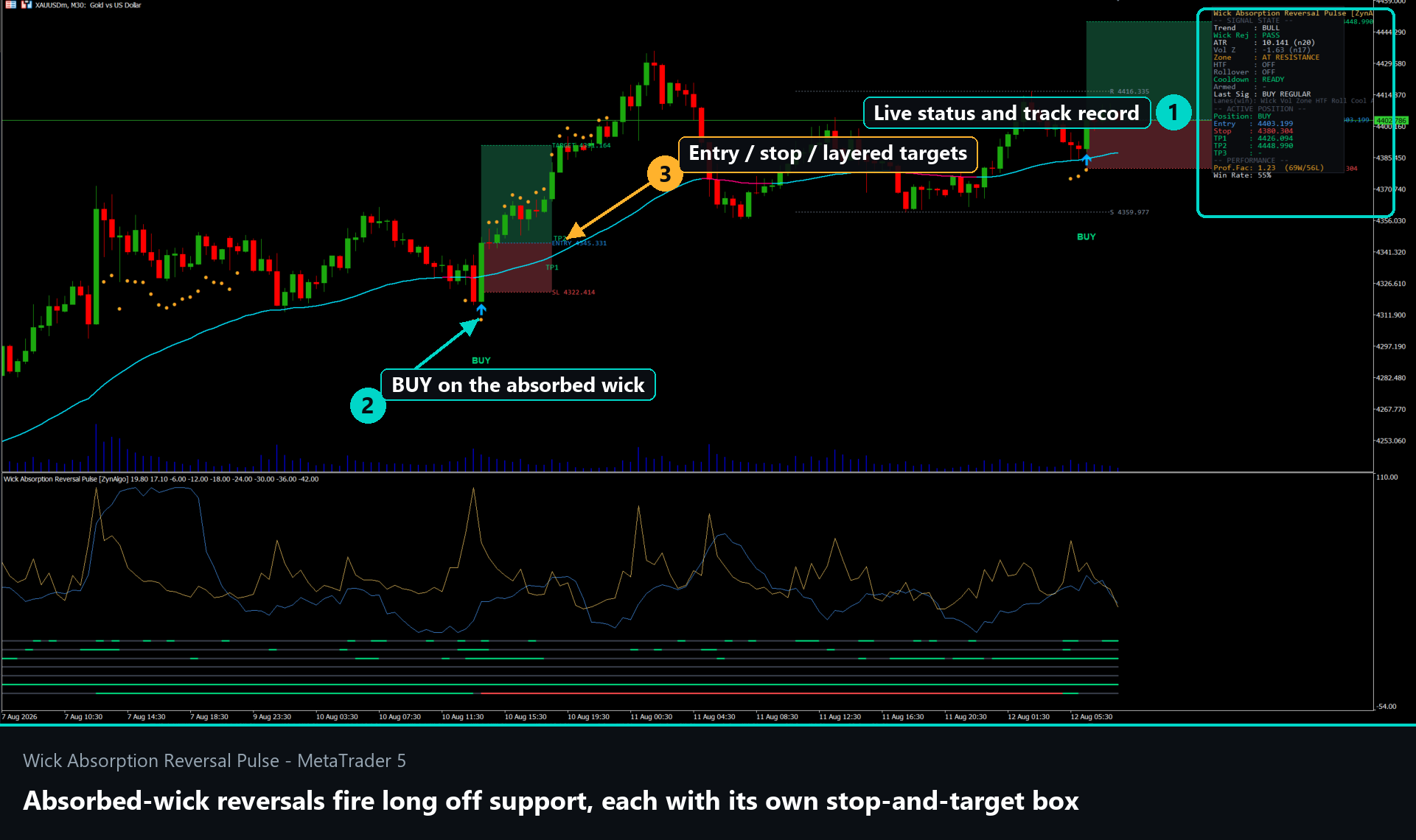
- The rejection candle is scored on wick-to-body dominance and where the close lands in its range
- The volume z-score measures whether participation was abnormal for that lookback
- The mistake this avoids is trading every long tail - a wick without elevated volume is exactly the rejection that fails
How the absorption setup is defined
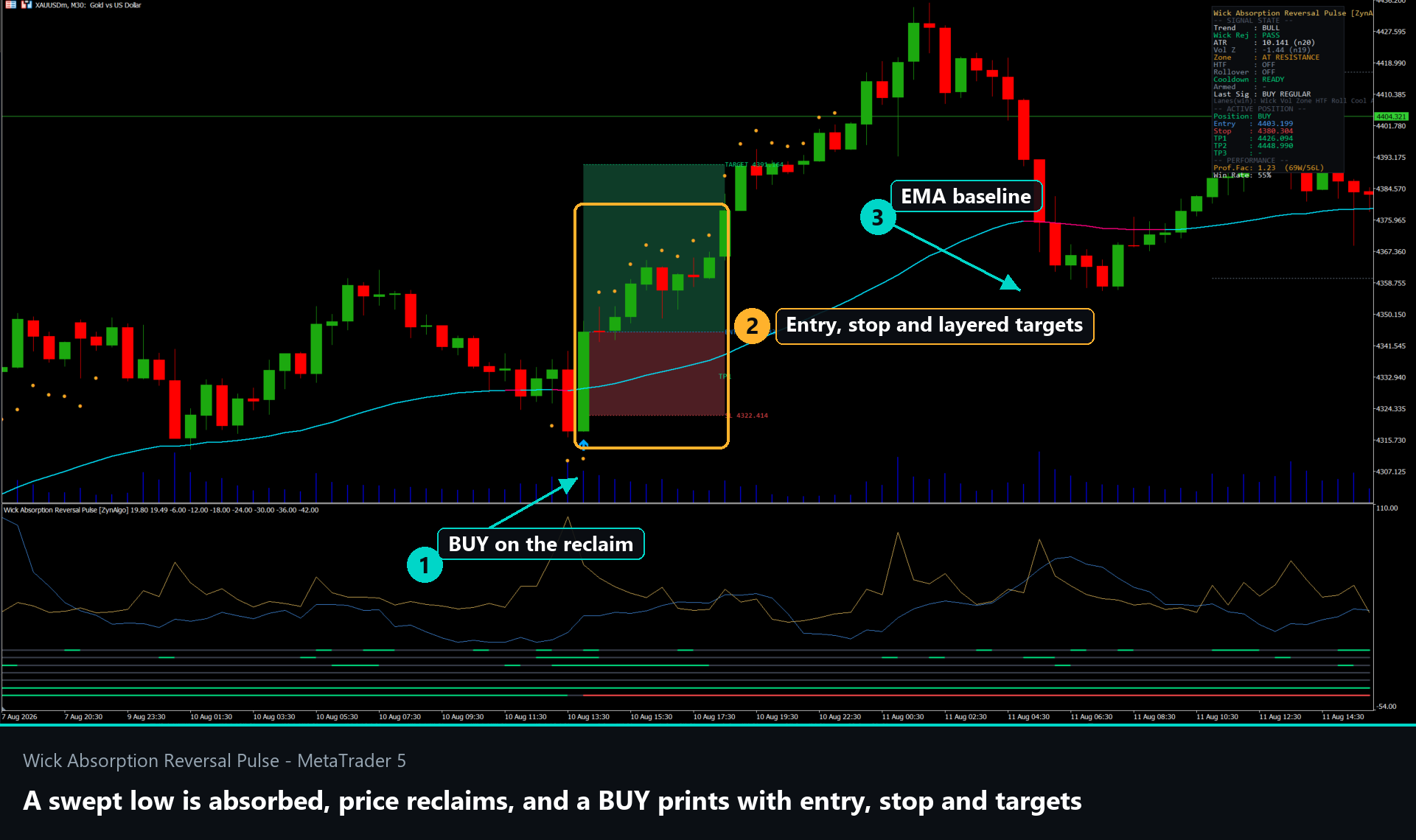
- Wick - the lower wick (for longs) at least WickRatio times the body and above the minimum wick points
- Volume - the tick-volume z-score elevated over its lookback, marking abnormal participation
- Zone - the candle within retest distance of a recent support/swept-low for longs, or resistance/swept-high for shorts
- Reclaim - the close returns into the upper half of the candle for a BUY, lower half for a SELL
From rejection to signal: reading an arrow
Signals are confirmed on closed candles, with follow-through required in the default mode.
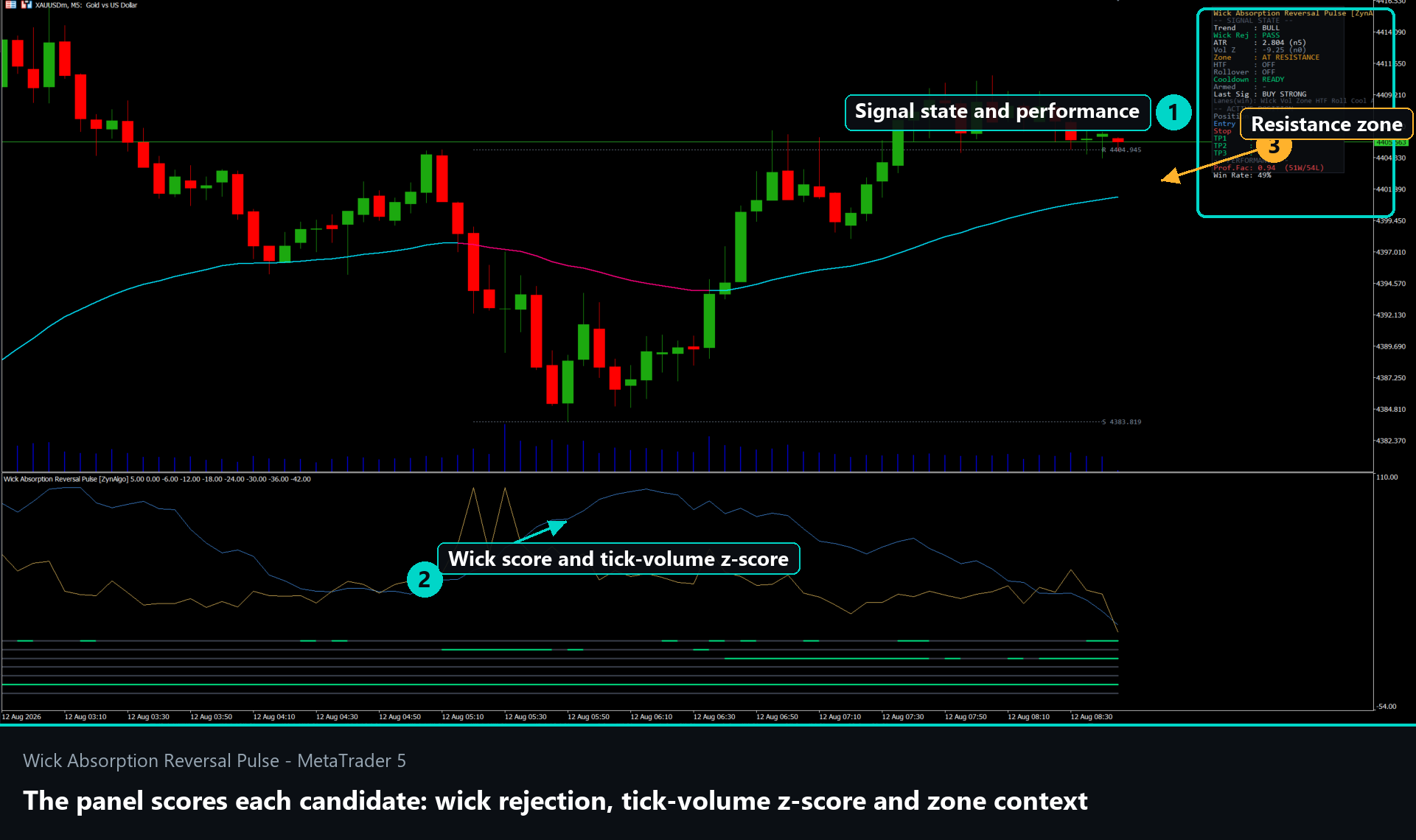
A BUY prints when:
- A candle prints a lower wick at least WickRatio times its body, with elevated tick-volume z-score
- Close returns above the wick midpoint and price is at support or a swept low
- The next bar trades above the rejection candle high (skipped only in aggressive mode)
- The candle clears the minimum ATR fraction and the EMA trend filter allows it
A SELL is the mirror image: an upper-wick rejection with elevated volume at resistance, close back below the wick midpoint, and a next-bar break below the rejection low, with the same filters.
What appears on the chart:
- Support/resistance and swept-liquidity zones, the scored rejection candles and a status panel with wick ratio and volume z-score
- A BUY or SELL arrow with entry at confirmation, a stop beyond the wick extreme plus a buffer, TP1 at the nearest opposing micro swing and TP2 at the prior range midpoint or edge, with optional break-even after 1R
- Alerts for BUY Absorption Pulse, SELL Absorption Pulse, zone retest and confirmation failed, each carrying the wick ratio and volume z-score
Is Wick Absorption Reversal Pulse right for you?
It fits you if:
- You trade rejection reversals at support, resistance and swept levels
- You want a wick filtered by participation rather than every long tail
- You would rather have the stop and targets attached to the signal
- You work on gold M1-M15, forex majors M5-H1 or indices M1-M5, mostly in the London and New York sessions
It fits you less well against a strong higher-timeframe trend, unless you enable countertrend mode, and around low-liquidity rollover. Spot FX tick volume varies by broker, so absorption here is an approximation, not order-book evidence - this is not a Bookmap or a real delta feed, and no such claim is made.
Installing it: copy the .ex5 file into the MQL5/Indicators folder inside your terminal's data folder, refresh the Navigator panel in MetaTrader 5, then drag Wick Absorption Reversal Pulse onto the chart. Every threshold above is editable in the Inputs tab.
-> Browse the ZynAlgo marketplace
This indicator is provided for educational purposes only and does not constitute financial advice. Trading involves risk; past performance does not guarantee future results.
- v1Jul 22, 2026
Initial release
Why long wicks fail: filtering wick reversals with volume participation
Most long-wick reversals fail because they drift rather than absorb. This article explains why a wick needs elevated participation to matter and how to separate real absorption from a cheap wick.
Why Long Wick Reversals Fail Without Volume, and How to Filter Them
A wick alone does not prove absorption. Without elevated volume behind it, that rejection may simply drift back. This article explains how to combine wick structure with tick-volume participation to avoid false reversal setups.