
Carry Unwind Radar
Carry trades look calm right up until they are not. Carry Unwind Radar reads carry pressure and volatility stress together on MetaTrader 5, so a funding-driven trend and the fast unwind that ends it are two different, labelled signals rather than one late arrow.
Key benefits
- Carry context, not a passive dashboard - swap/carry bias, trend and volatility are combined into an actual BUY or SELL, with a separate Unwind Warning when funding stress builds
- Volatility-aware - an ATR fast/slow ratio blocks entries into a volatility panic and flags when carry is starting to cool or snap
- Risk drawn with the signal - an ATR-buffered stop beyond the last swing plus 1R/extension targets arrive with the arrow
- Tuned for the pairs that carry - built around JPY crosses and G10 FX, with an optional risk-off filter
How it works
A signal needs the carry side, the trend and the volatility state to agree on a closed candle: carry bias favouring one direction, price holding the correct side of EMA 50 and EMA 200, and the ATR ratio confirming rather than panicking. When funding strength flips against the trend, the Radar raises an unwind signal instead. Full rule set is in the Manual.
What's included
MetaTrader 5 indicator file (.ex5), with carry preset, manual swap override, EMA and ATR lengths, volatility panic ratio, spread cap and news blackout all open in the Inputs tab.
Best for
Swing and intraday traders on JPY crosses and G10 FX, M15 to H4, who trade carry-driven trends and want to be warned before the unwind, not after.
Get access
-> Browse the ZynAlgo marketplace
Trading involves risk. This indicator is an analysis tool for educational purposes and does not guarantee results.
Carry Unwind Radar
What has to line up before a signal can print
Carry Unwind Radar is a carry-and-volatility signal indicator for MetaTrader 5. It is built for the pairs where funding matters - JPY crosses and G10 FX - and its job is to separate a carry-supported trend from the moment that trend starts to unwind.
Every closed candle is measured against:
- Carry bias - broker swap direction, or a manual carry score where broker metadata is unreliable
- Trend - whether price holds the correct side of EMA 50 and EMA 200, and which way EMA 50 is sloping
- Volatility state - ATR(14) against a slower ATR baseline, read as calm, cooling, or panic
- Context filters - minimum spread, optional higher-timeframe trend agreement, and a high-impact-news blackout
Only when carry, trend and volatility point the same way does a BUY or SELL arrive - and when funding strength turns against an open trend, an Unwind Warning is raised instead.
Reading carry pressure and the unwind state
Most carry tools show a static macro table. Carry Unwind Radar turns the same inputs into a live state, because the risk in a carry trade is not the direction - it is how fast it reverses.
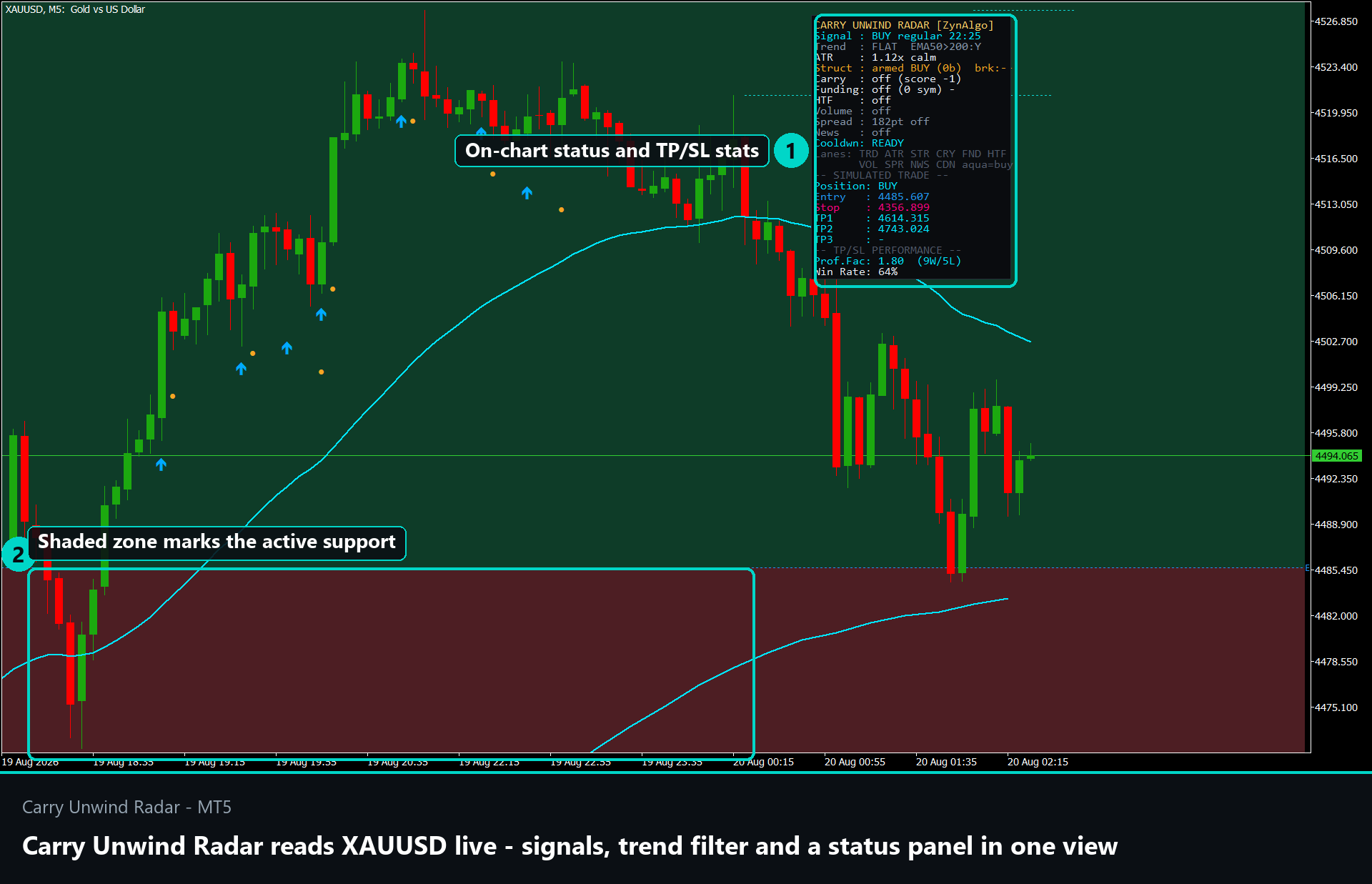
- Carry side - the funding advantage, from swap or a configured carry score, sets which direction is eligible
- Unwind mode - when the funding currency strengthens for several bars while volatility expands, the trend is treated as at risk and long/short eligibility flips
- The status panel reports the live carry side, the ATR ratio and the current state so you can see stress building before a signal changes
How the volatility gate is defined
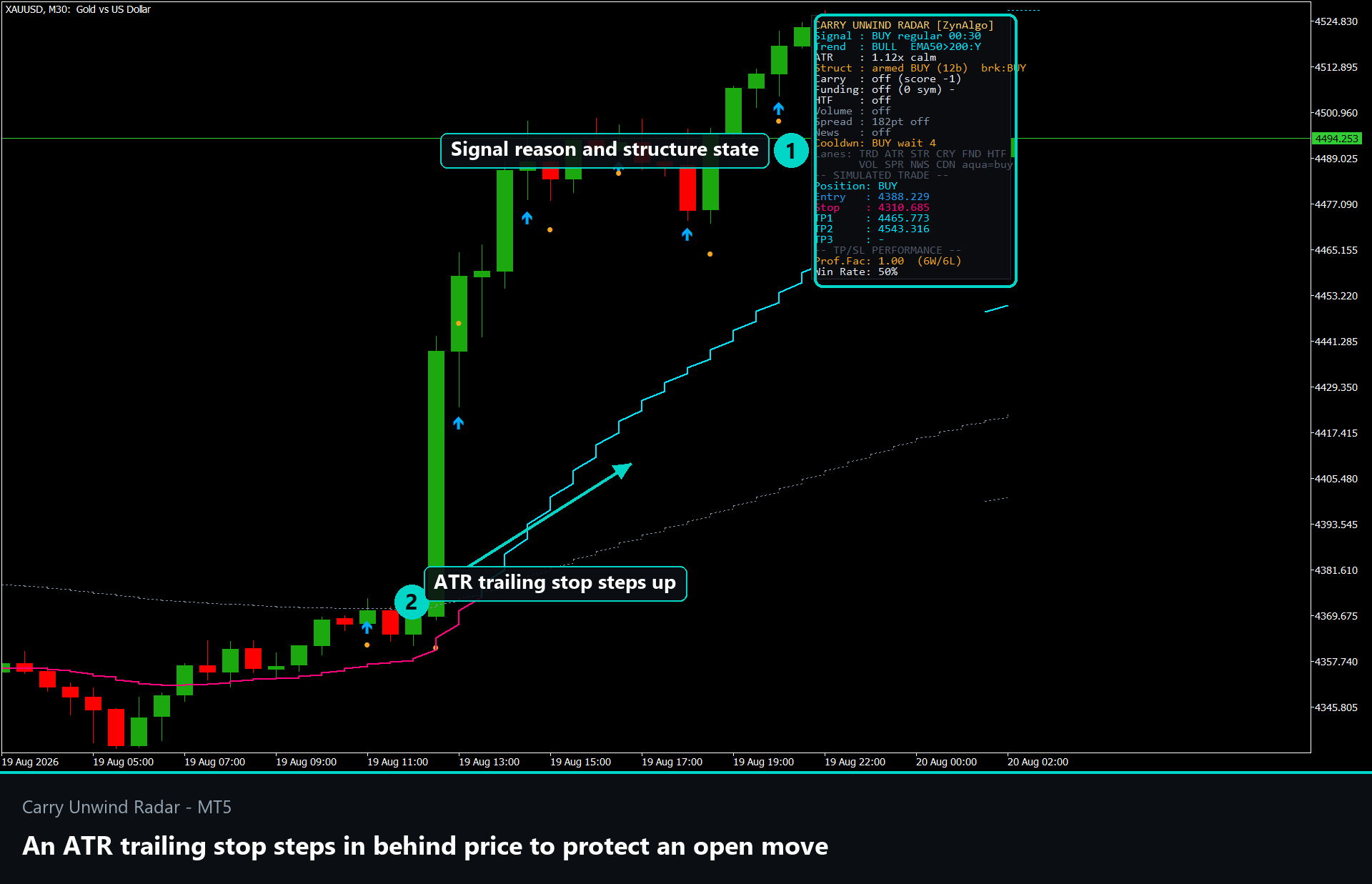
- ATR ratio - ATR(14) divided by a slower ATR reading; a value below the panic threshold means orderly conditions, above it means a volatility spike
- Cooling - the ratio easing back down after a spike is what arms a fresh continuation rather than chasing the spike itself
- Carry stress - a break of the last swing low in a long-funded pair, or swing high in a short-funded pair, while the ratio expands, is what confirms an unwind
From context to signal: reading an arrow
Signals are evaluated on closed candles only, never on the candle still forming.
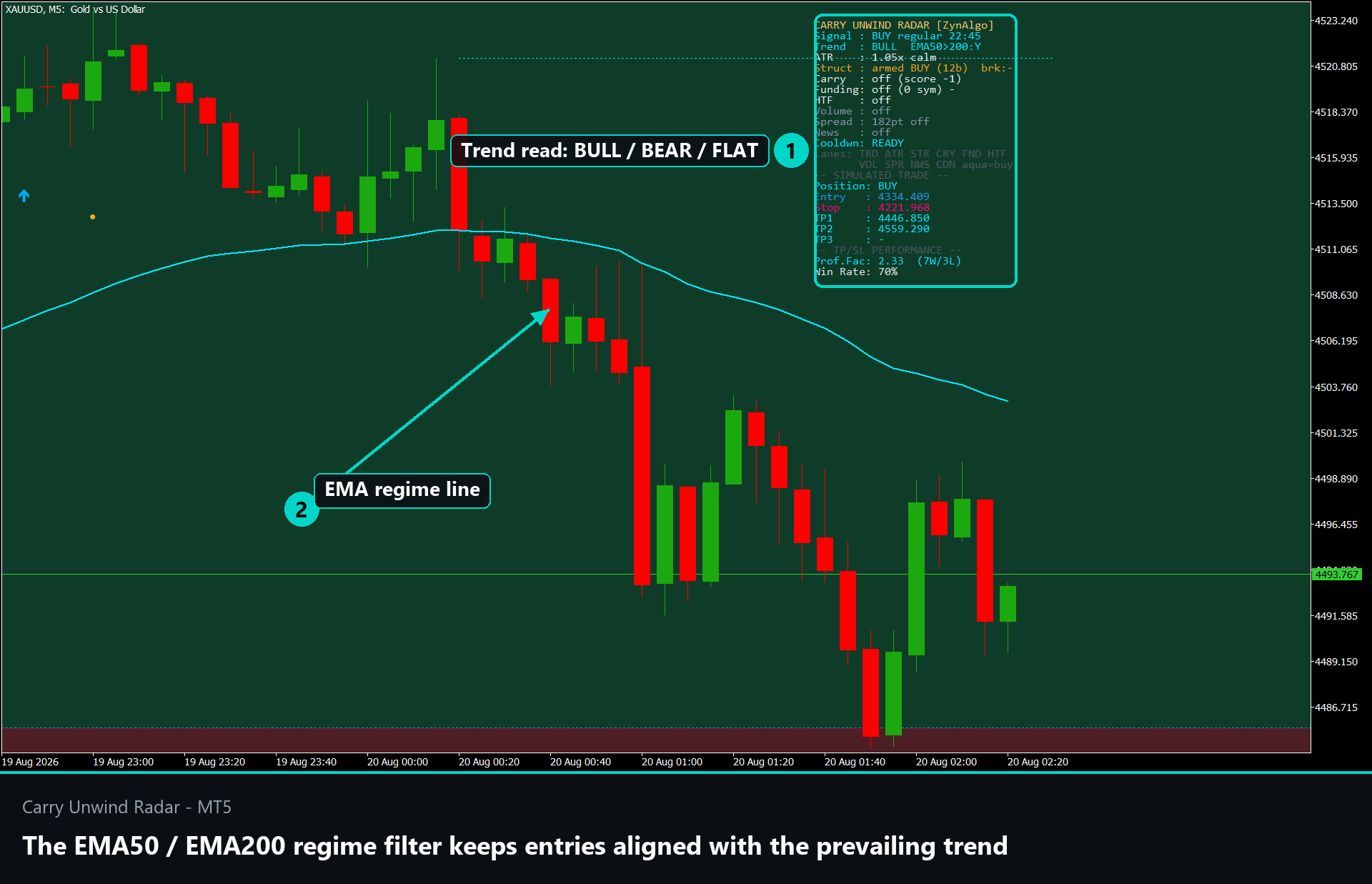
A BUY prints when:
- The carry side favours long, or unwind mode has cleared to the upside
- Price closes above EMA 50 and EMA 200 with EMA 50 rising
- The ATR ratio is below the panic threshold or cooling after a spike
- Spread is within the cap, the news blackout is not active, and any higher-timeframe filter agrees
A SELL is the mirror image: carry favouring short or a detected unwind, price below EMA 50 and EMA 200 with EMA 50 falling, and the ATR ratio confirming carry stress rather than a random spike.
What appears on the chart:
- A signal arrow with entry at the signal candle close, a stop beyond the latest swing plus an ATR buffer, and targets at 1R and a prior daily high/low or ATR extension
- Dedicated alerts for Carry BUY, Carry SELL, Unwind Warning, Volatility Panic Blocked and Carry Score Flip, each carrying the pair, timeframe, carry score, spread and ATR ratio
Is Carry Unwind Radar right for you?
It fits you if:
- You trade JPY crosses or G10 FX and care about funding as much as direction
- You want to be warned when a carry trend is starting to come apart, not after it already has
- You would rather the stop and target were measured with the signal
- You work on M15 to H4 and hold positions through sessions
It fits you less well if you trade instruments where carry is irrelevant or you want a signal on every swing. Carry differs by broker and rollover rules, so this is a volatility-aware signal filter for carry continuation and unwind pressure, not a macro forecast.
Installing it: copy the .ex5 file into the MQL5/Indicators folder inside your terminal's data folder, refresh the Navigator panel in MetaTrader 5, then drag Carry Unwind Radar onto the chart. Because broker swap metadata varies, check the carry preset and manual override in the Inputs tab for your pairs.
-> Browse the ZynAlgo marketplace
This indicator is provided for educational purposes only and does not constitute financial advice. Trading involves risk; past performance does not guarantee future results.
- v1Jul 22, 2026
Initial release