
Coil Edge Reversal Pulse
A tight range sitting on the edge of a bigger range usually breaks the wrong way first. Coil Edge Reversal Pulse maps that compression shelf on MetaTrader 5 and signals the fade back after a failed release, instead of chasing the first break.
Key benefits
- The trap drawn for you - the active compression shelf, its midpoint and the rolling-range extreme are shown live, so you see the setup forming
- Fade the failed release - a signal needs a release attempt that gets rejected back inside the shelf, then a real trigger close, not just a poke
- Risk already measured - stop beyond the fake-release wick, targets at the opposite shelf edge, the shelf projection and 2R
- Quiet filters - shelf-height, compression-age, volume and cooldown checks keep it from firing on structureless chop
How it works
A shelf is confirmed when band-width and ATR percentile stay compressed for 3-18 bars near a rolling-range extreme. Price attempts a release, closes back inside the shelf, then a trigger candle closes beyond the shelf midpoint with a body above 0.20 ATR - and only then does a BUY or SELL print on the closed candle. Full rule set is in the Manual.
What's included
MetaTrader 5 indicator file (.ex5), with ATR and range lookbacks, body/ATR threshold, shelf limits, spread cap, cooldown and TP/SL multipliers open in the Inputs tab.
Best for
Intraday and scalping traders on gold, indices and crypto, M1 to M15, who trade fades off compression at range edges rather than momentum breakouts.
Get access
-> Browse the ZynAlgo marketplace
Trading involves risk. This indicator is an analysis tool for educational purposes and does not guarantee results.
Coil Edge Reversal Pulse
What has to line up before a signal can print
Coil Edge Reversal Pulse is a compression-and-fade indicator for MetaTrader 5. It works one situation: a tight micro-range - a coil shelf - sitting near a rolling-range extreme, where the first release often fails and snaps back. Outside that structure it stays quiet.
Every closed candle is measured against:
- Compression - Bollinger band-width percentile and ATR percentile both sitting below their thresholds for 3-18 bars
- Edge location - the shelf low in the lower 45% of the rolling 60-bar range for longs, or the shelf high in the upper 45% for shorts
- Failed release - a release attempt that closes back inside the shelf
- Trigger - a candle closing beyond the shelf midpoint with a body above 0.20 ATR
- Context filters - shelf height within its configurable ATR limits, compression not older than 90 bars, tick-volume and cooldown checks
What lands on your MetaTrader 5 chart is the shelf box, its midpoint, the range-extreme zones, a compression ribbon, the fake-release markers, and a signal with stop and targets already measured.
The coil shelf and the failed release
Most squeeze tools signal the break. Coil Edge Reversal Pulse signals the failure of the break, because a compression at the edge of a range leaks one way and reverses far more often than it runs.
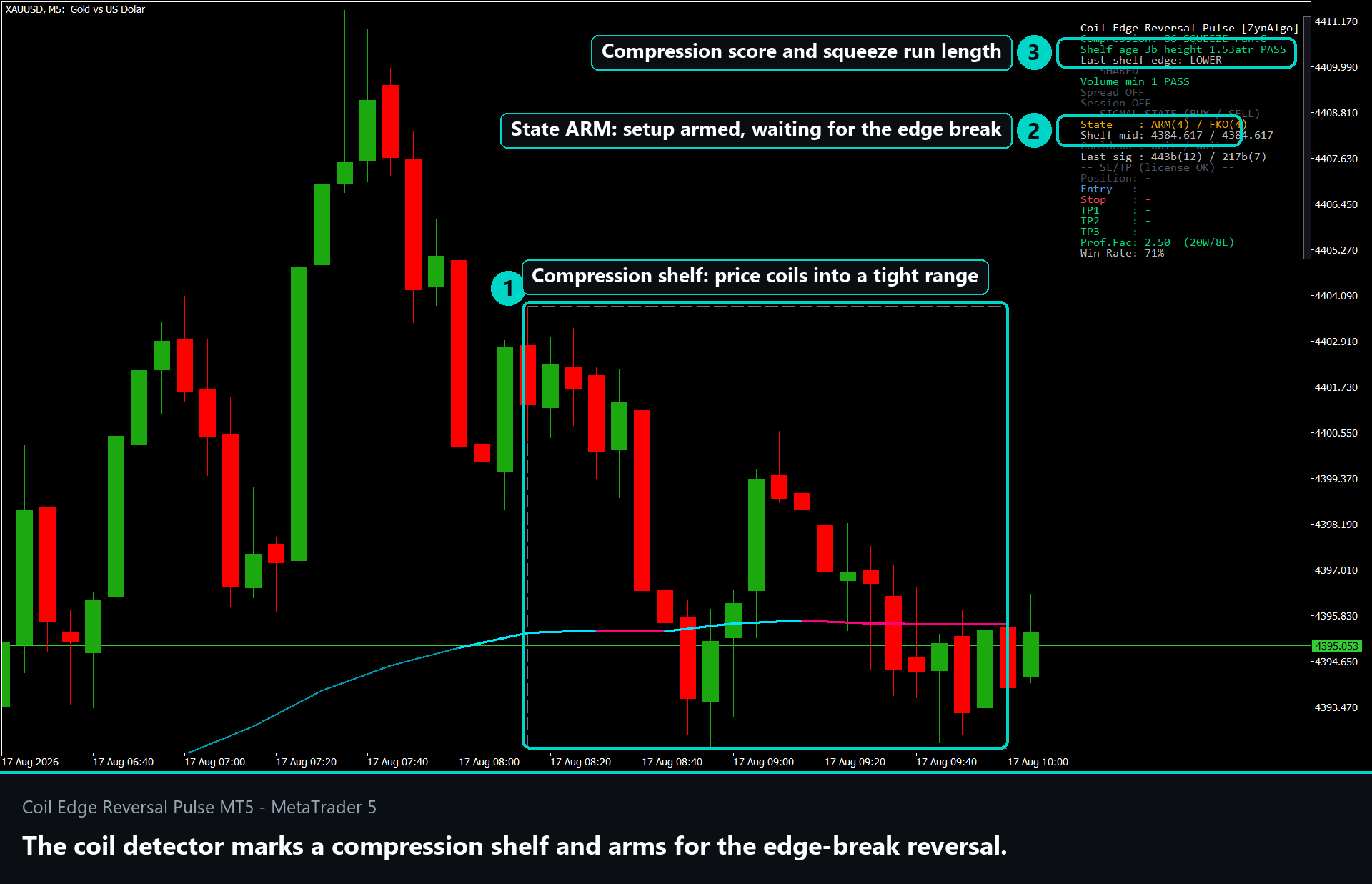
- The compression shelf is drawn while band-width and ATR percentile stay below threshold, with its age counted on the panel
- A release attempt that closes back inside the shelf arms the fade in the opposite direction
- The mistake this is built around is buying the first candle out of a tight range at an extreme - exactly the move most likely to be a trap
How the shelf and trigger are defined
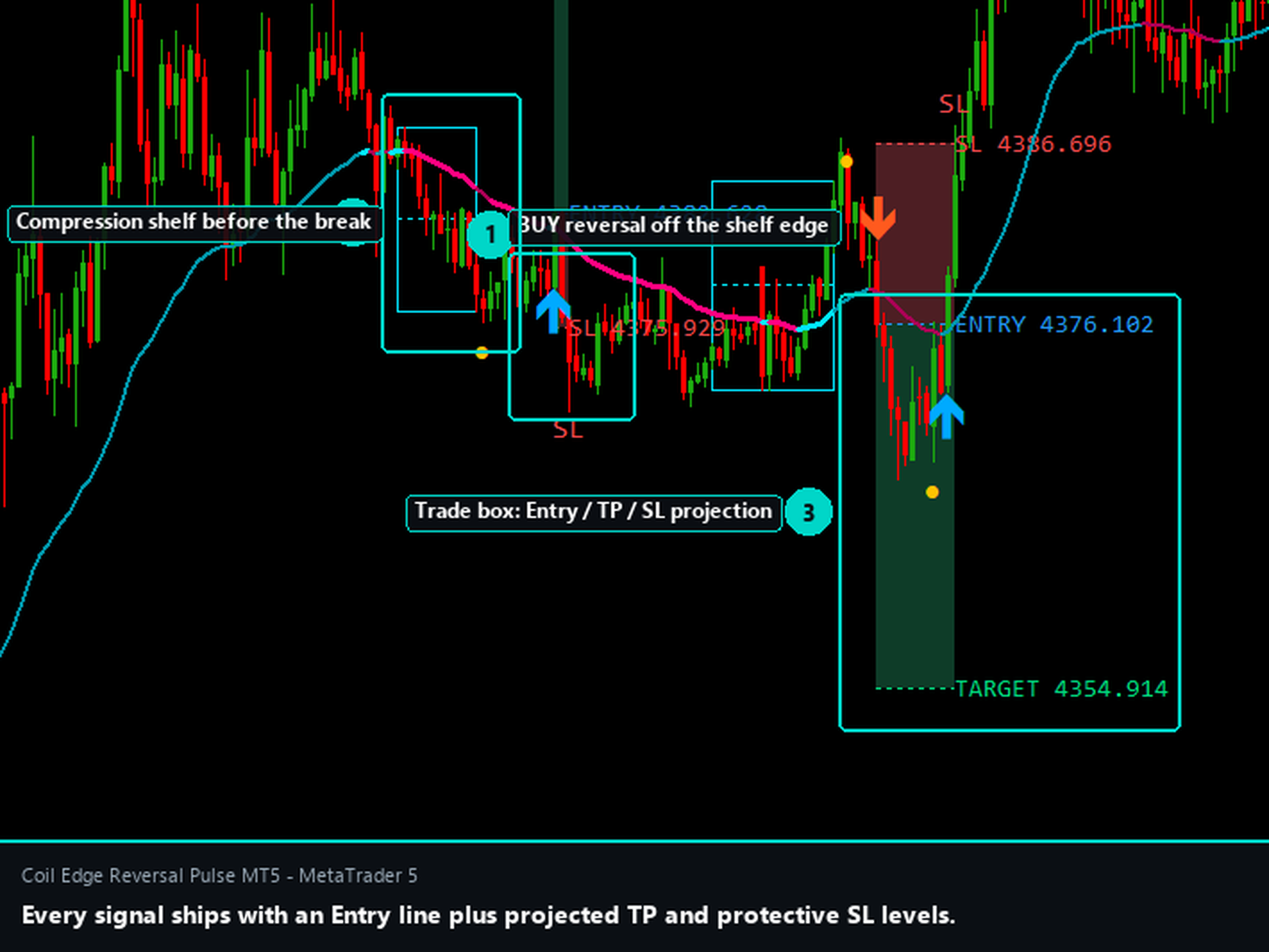
- Shelf - counted over 3-18 bars while band-width and ATR percentile are compressed; rejected if compression lasts more than 90 bars
- Edge - the shelf has to sit in the outer 45% of the rolling 60-bar range for the signal to be a genuine edge fade
- Fake release - a probe beyond the shelf that closes back inside marks the failed expansion
- Trigger - the confirming candle closes beyond the shelf midpoint or opposite edge with a body of at least 0.20 ATR, and shelf height within its configurable ATR limits
From armed to fired: reading a signal
Signals are confirmed on closed candles, and repeated same-direction signals are blocked until a new shelf forms or price moves 1 ATR away.
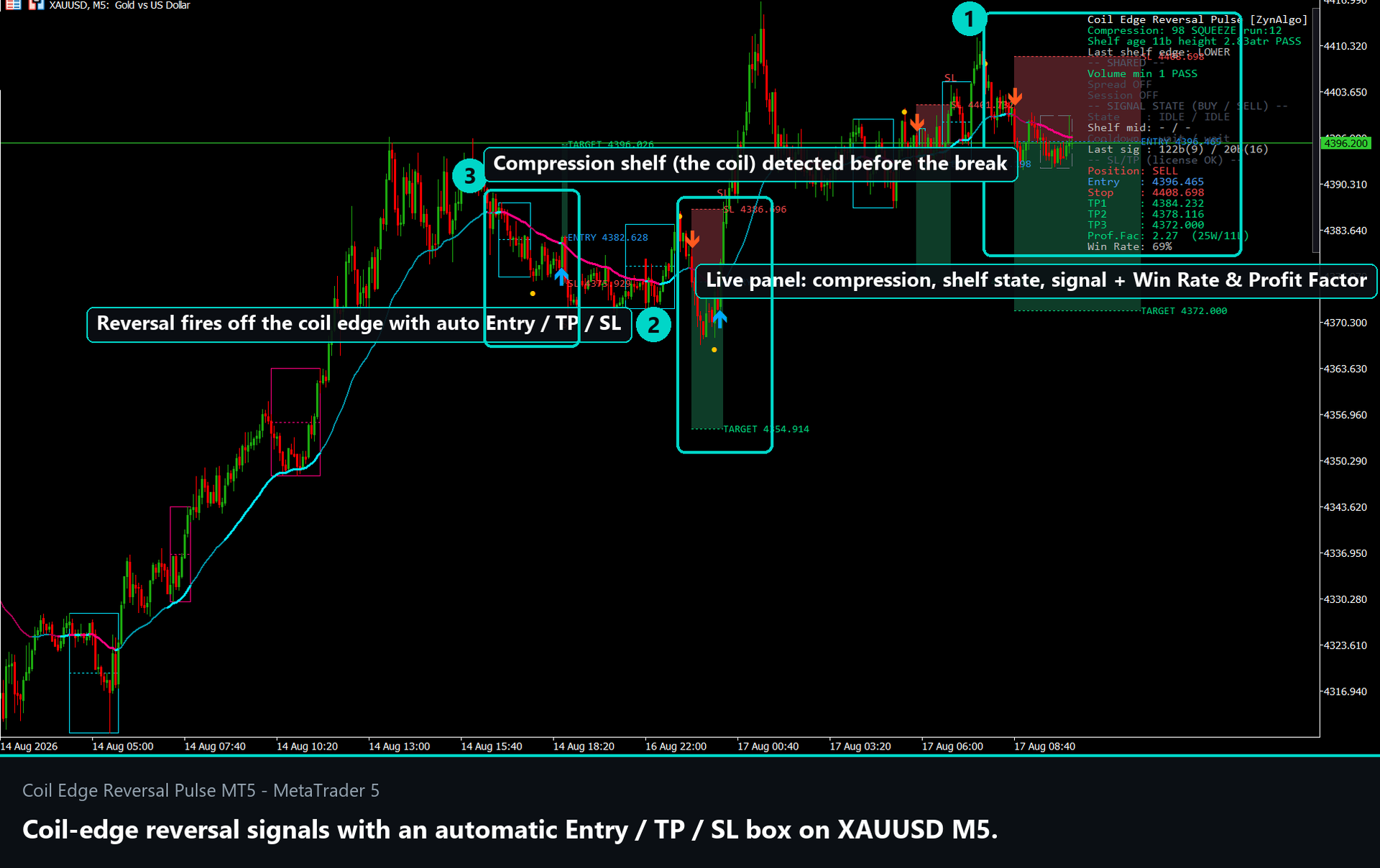
A BUY prints when:
- A shelf is compressed near the lower edge of the rolling range
- Price attempts a downside release and closes back inside the shelf
- A trigger candle closes above the shelf midpoint or shelf high with a body above 0.20 ATR
- Tick volume, spread and cooldown filters allow the bar
A SELL is the mirror image: compression near the upper edge, a failed upside release closing back inside, then a trigger close below the shelf midpoint or shelf low with the same body, volume and spread checks.
What appears on the chart:
- A BUY or SELL arrow with entry at the trigger close, a stop beyond the fake-release wick plus 0.10 ATR, and targets at the opposite shelf edge, the shelf-height projection and 2R
- Alerts for setup armed, BUY confirmed, SELL confirmed, invalidation and opposite signal, each naming the symbol, timeframe, direction and trigger reason
- An optional time stop after 8 bars on M1-M5 or 5 bars on M15
Is Coil Edge Reversal Pulse right for you?
It fits you if:
- You trade gold, indices or crypto intraday on M1 to M15
- You would rather fade a failed release at a range edge than chase the breakout
- You want the shelf, the trap and the risk drawn for you
- You are comfortable with an active tool that looks for around five setups a day on liquid markets
It fits you less well on strong one-way trend days, when compression at an edge can resolve into a real breakout. Choppy news bars and widened spreads can also produce failed fades, which is why the spread, volatility and cooldown filters matter. This is a deterministic signal assistant, not prediction software.
Installing it: copy the .ex5 file into the MQL5/Indicators folder inside your terminal's data folder, refresh the Navigator panel in MetaTrader 5, then drag Coil Edge Reversal Pulse onto the chart. Every threshold above is editable in the Inputs tab.
-> Browse the ZynAlgo marketplace
This indicator is provided for educational purposes only and does not constitute financial advice. Trading involves risk; past performance does not guarantee future results.
- v1Jul 22, 2026
Initial release

Why Tight Ranges at Range Edges Fail and How to Fade Them
A compression shelf at the edge of a range usually leaks one way and snaps back instead of breaking out. Coil Edge Reversal Pulse signals the fade after the failed release, not the false breakout.

Why my tight range breakout keeps reversing on me (and how to fade it)
You buy the first candle out of a tight range at the edge of the rolling range, and it snaps back against you. Coil Edge Reversal Pulse marks the failed release and signals the fade instead.