
Open Price Flip Pulse
Daily and session opens act as intraday magnets and traps. Open Price Flip Pulse tracks the current symbol's opens on MetaTrader 5 and fires when price rejects one side, reclaims the open, and confirms with body momentum.
Key benefits
- The open as a level, drawn live - the active open line and an ATR-width envelope are shown, with a bias ribbon for which side price is accepted on
- Reject and reclaim, not chase - a signal needs a rejection wick beyond the open band and a confirmed reclaim, not a single-candle guess
- Risk already measured - stop beyond the sweep wick plus 0.15 ATR, targets at 1R and the opposite side of the open envelope
- Quiet filters - ATR, spread, reclaim-body and distance-from-open checks keep it selective
How it works
Price trades below the active open band by at least 0.20 ATR, leaves a lower rejection wick, closes back above the band, and the next bar closes above the reclaim high or a fast EMA - a BUY. The setup stays armed for 4 bars so the trigger can follow the reclaim. Shorts mirror it, on closed candles. Full rule set is in the Manual.
What's included
MetaTrader 5 indicator file (.ex5), with ATR and EMA lengths, open/session mode, body threshold, spread cap and TP/SL multipliers open in the Inputs tab.
Best for
Intraday and scalping traders on gold and forex majors M5-M15 and indices M1-M5 who trade reactions around the daily and session open.
Get access
-> Browse the ZynAlgo marketplace
Trading involves risk. This indicator is an analysis tool for educational purposes and does not guarantee results.
Open Price Flip Pulse
What has to line up before a signal can print
Open Price Flip Pulse is an open-reclaim reversal indicator for MetaTrader 5. It works one recurring intraday situation: price pushes past the daily or session open, gets rejected, and flips back through it. Everything is measured on the attached chart symbol only.
Every closed candle is measured against:
- Open band - the active daily or session open with an ATR-width envelope around it
- Rejection - price trading beyond the band by at least 0.20 ATR and leaving a rejection wick
- Reclaim - a close back on the other side of the open band
- Confirmation - the next bar closing beyond the reclaim bar's extreme or a fast EMA
- Context filters - ATR floor, spread cap, reclaim-body size and distance from the open
Only when the rejection, the reclaim and the confirmation agree does a BUY or SELL arrive, with stop and targets already measured.
Why the open is the level that matters intraday
Most reversal tools react to any wick. Open Price Flip Pulse anchors to the open, because that is the level intraday traders defend and hunt, so a rejection and reclaim there carries more meaning than a random swing.
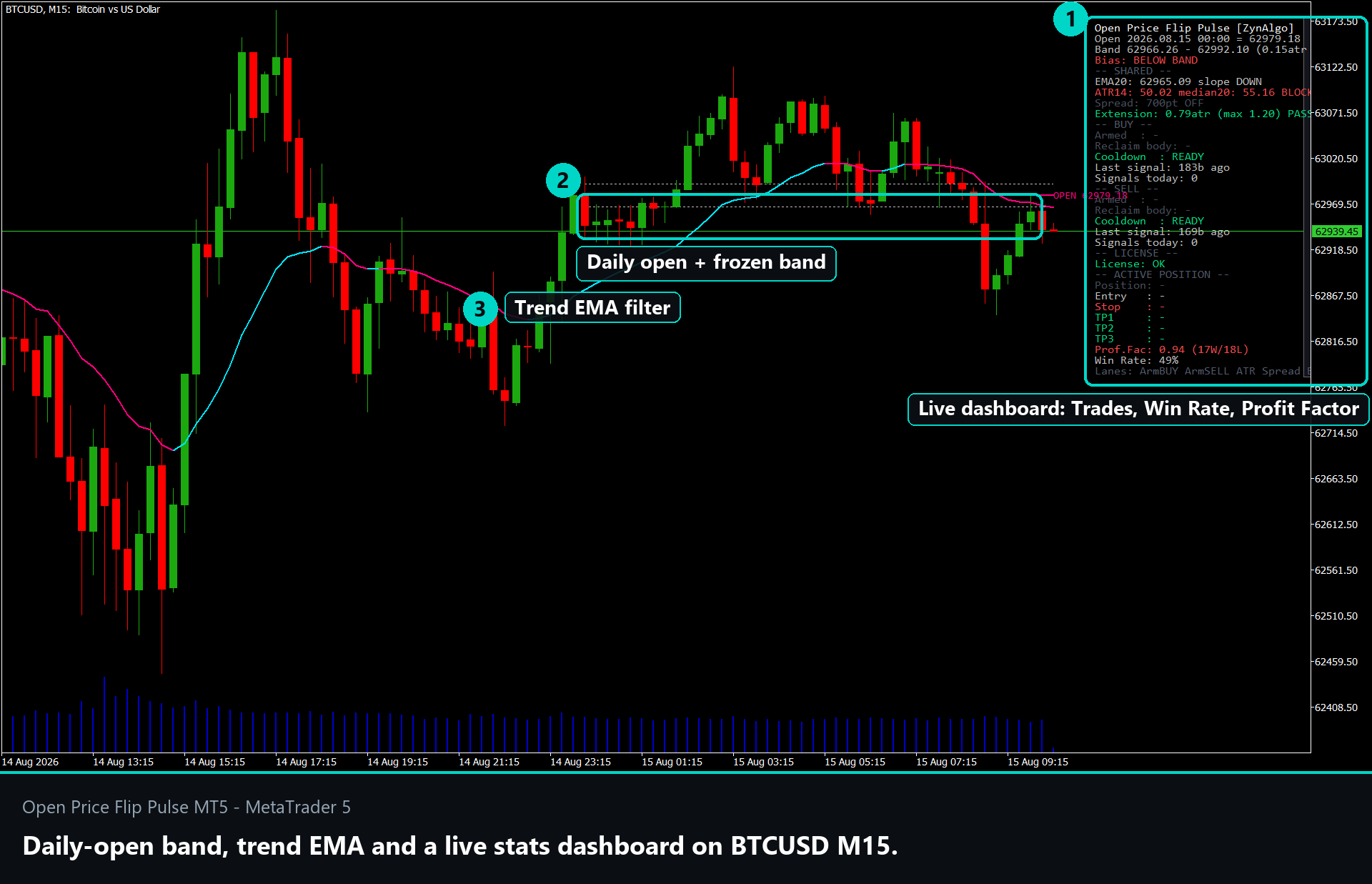
- The open line and its ATR envelope show the level and the tolerance band around it
- The bias ribbon turns green or red depending on which side price is being accepted on
- The mistake this avoids is fading the open the moment it is touched - the setup requires a genuine push beyond it that then fails
How the flip is defined
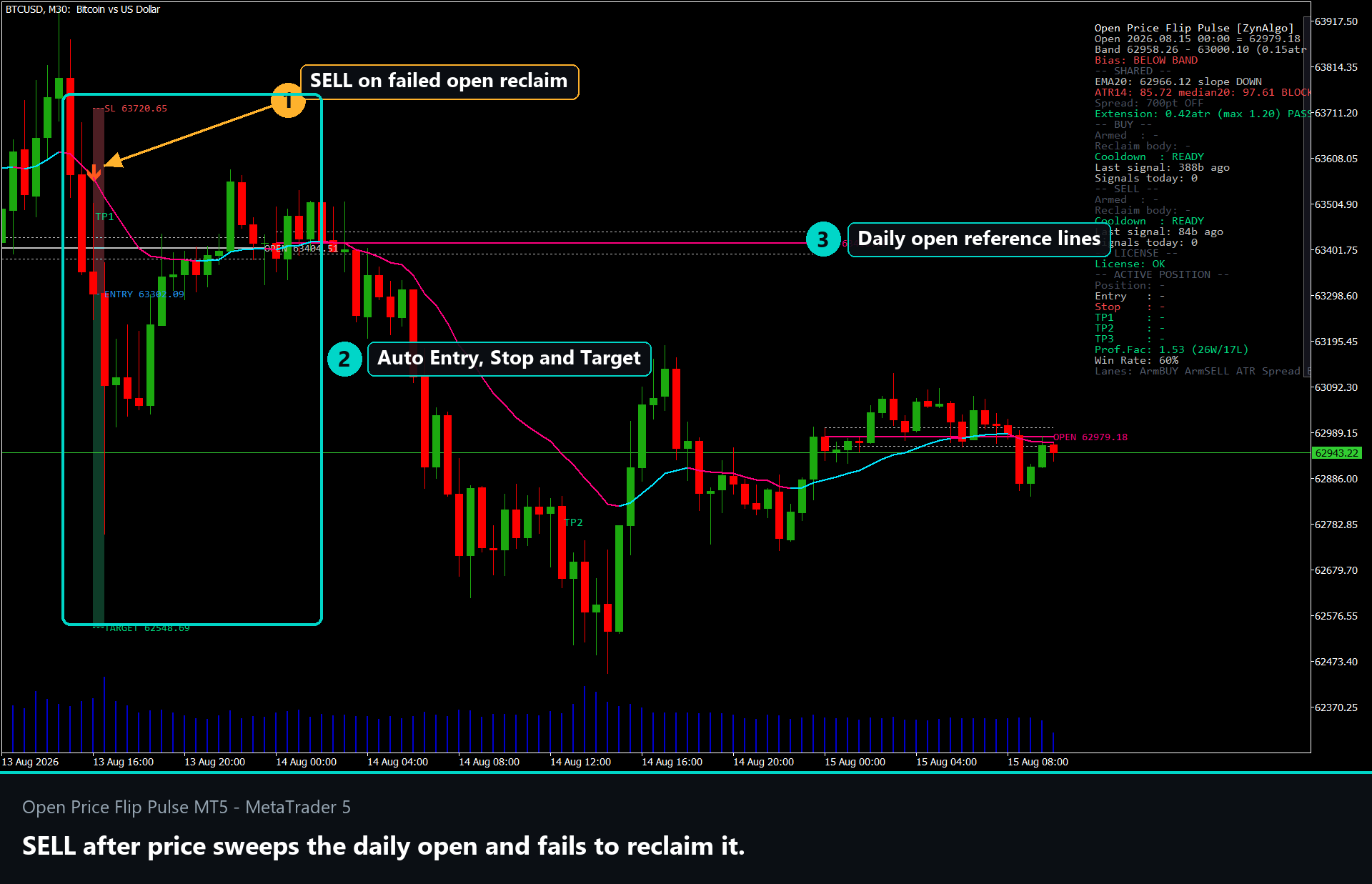
- Push - price trades beyond the open band by at least 0.20 ATR, marking a real probe rather than a touch
- Rejection wick - the probe candle leaves a wick on the far side, showing the level held
- Reclaim - a close back across the open band arms the setup for up to 4 bars
- Confirmation - the next bar closes beyond the reclaim bar's extreme or the fast EMA, with the reclaim body at least 35% of its range
From armed to fired: reading a signal
Signals are evaluated on closed candles only.
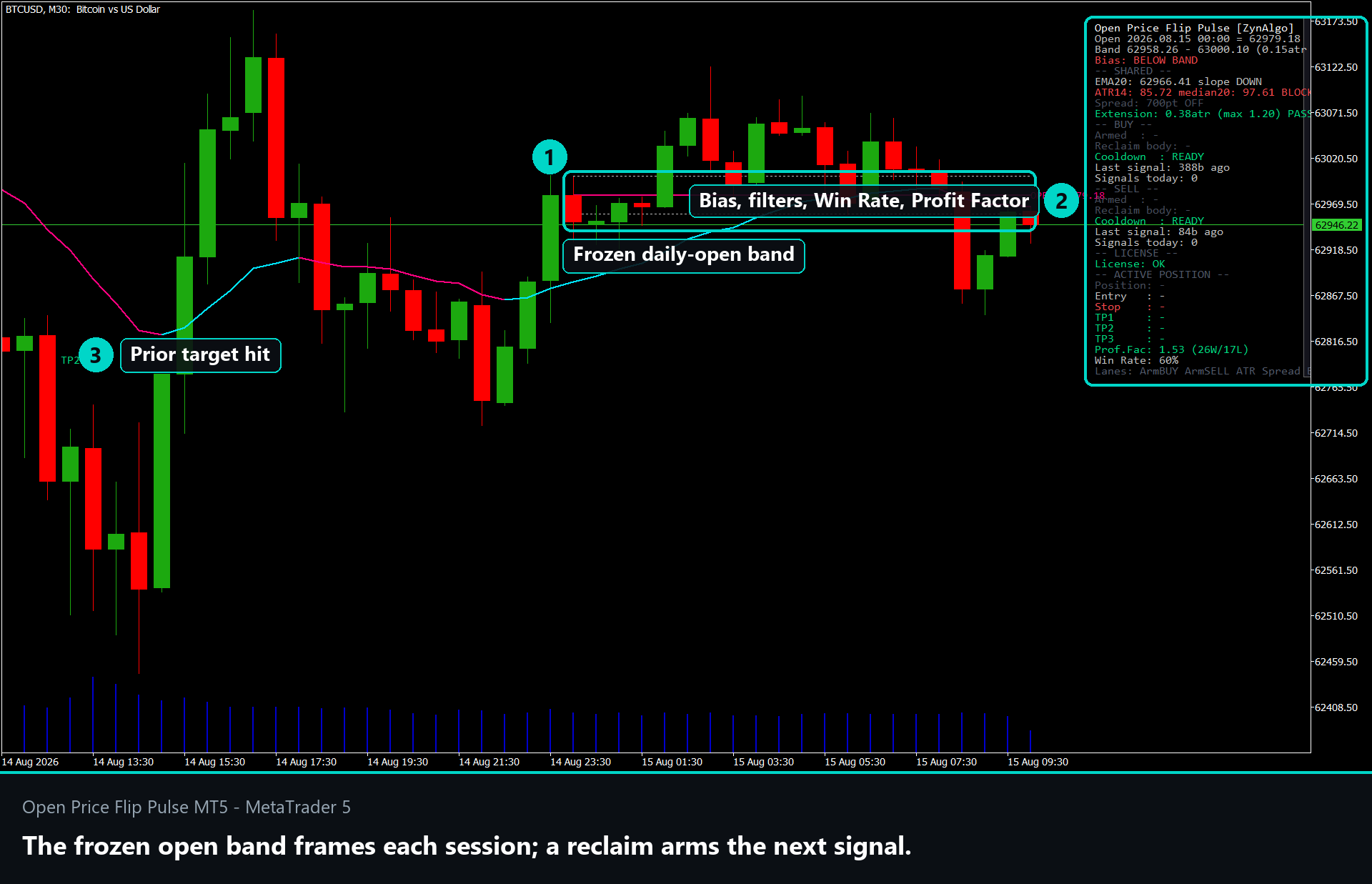
A BUY prints when:
- Price trades below the open band by at least 0.20 ATR and leaves a lower rejection wick
- Price closes back above the open band
- The next bar closes above the reclaim high or the fast EMA within the 4-bar window
- ATR, spread, body and distance filters allow the bar
A SELL is the mirror image: a push above the open band with an upper rejection wick, a close back below, then a confirming close below the reclaim low or fast EMA, with the same filters.
What appears on the chart:
- The daily/session open line, the ATR-width envelope, the bias ribbon and armed-sweep markers
- A BUY or SELL arrow with entry at the confirmation close, a stop beyond the sweep wick plus 0.15 ATR, TP1 at 1R and TP2 at the opposite side of the open envelope or 1.8R, with an optional EMA/ATR trail
- Alerts for setup armed, BUY confirmed, SELL confirmed, invalidation and opposite signal, each naming the symbol, timeframe and trigger reason
Is Open Price Flip Pulse right for you?
It fits you if:
- You trade intraday around the daily or session open on gold, forex majors or indices
- You would rather trade a confirmed reject-and-reclaim than fade the first touch
- You want the open level, the envelope and the risk drawn for you
- You are comfortable working on M1 to M15
It fits you less well on one-way trend days, when the open is broken and never reclaimed. Choppy news bars, widened spreads and very low volatility can also produce failed fades, which is why the ATR, spread and body filters matter. This is a deterministic signal assistant, not prediction software.
Installing it: copy the .ex5 file into the MQL5/Indicators folder inside your terminal's data folder, refresh the Navigator panel in MetaTrader 5, then drag Open Price Flip Pulse onto the chart. Every threshold above is editable in the Inputs tab.
-> Browse the ZynAlgo marketplace
This indicator is provided for educational purposes only and does not constitute financial advice. Trading involves risk; past performance does not guarantee future results.
- v1Jul 22, 2026
Initial release

Why My Fade at the Daily Open Gets Stopped Out (And How to Wait for the Flip)
You fade the daily open on the first touch and get run over. The open matters, but timing the rejection is the problem. Here's how to wait for the push, the fail, and the reclaim.

Why Your Open-Reject Trades Keep Failing Without Reclaim Confirmation
You fade the open on the first touch, then watch price rip through it. Open Price Flip Pulse waits for a push past, a rejection wick, a reclaim close, and confirmation before any signal prints.