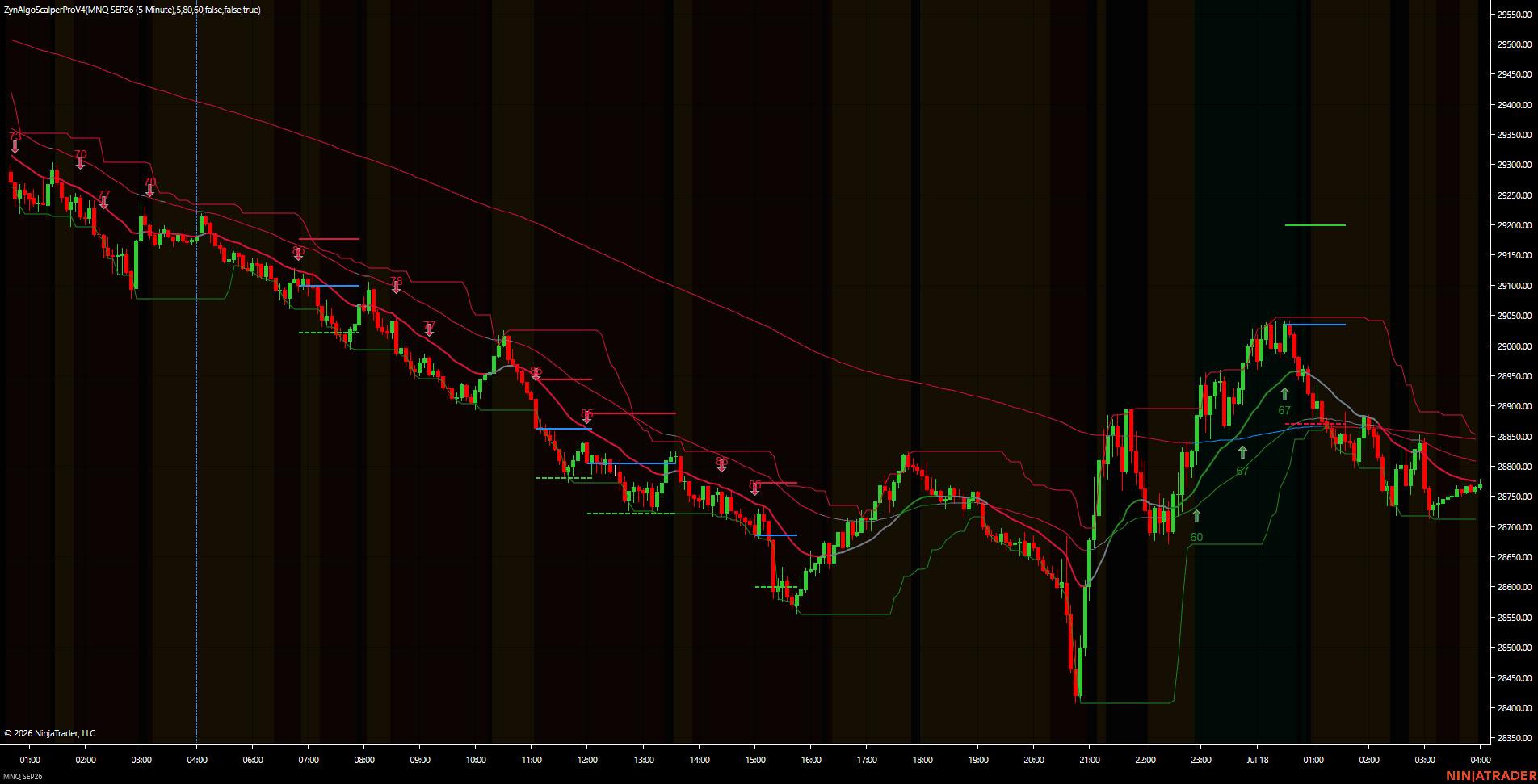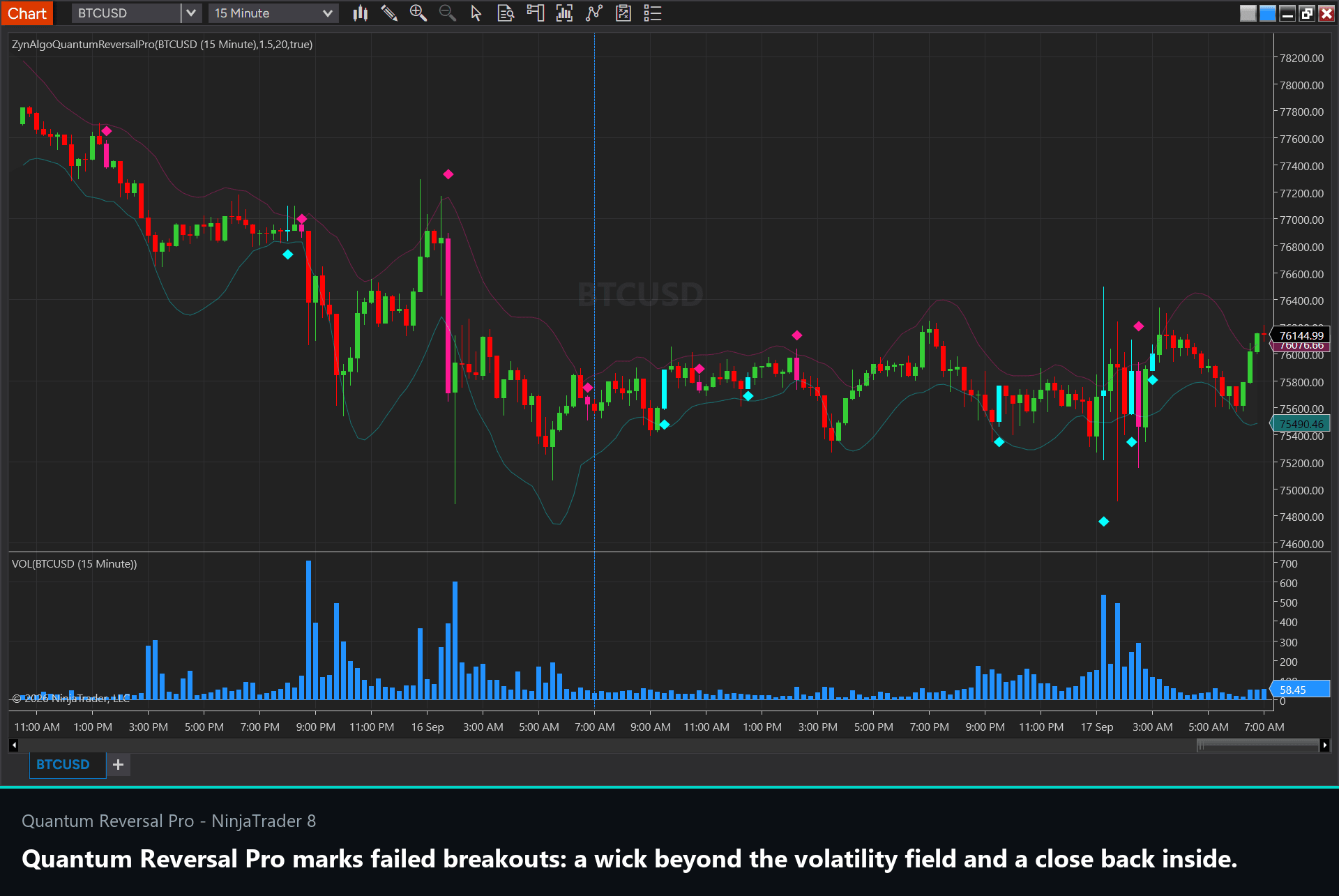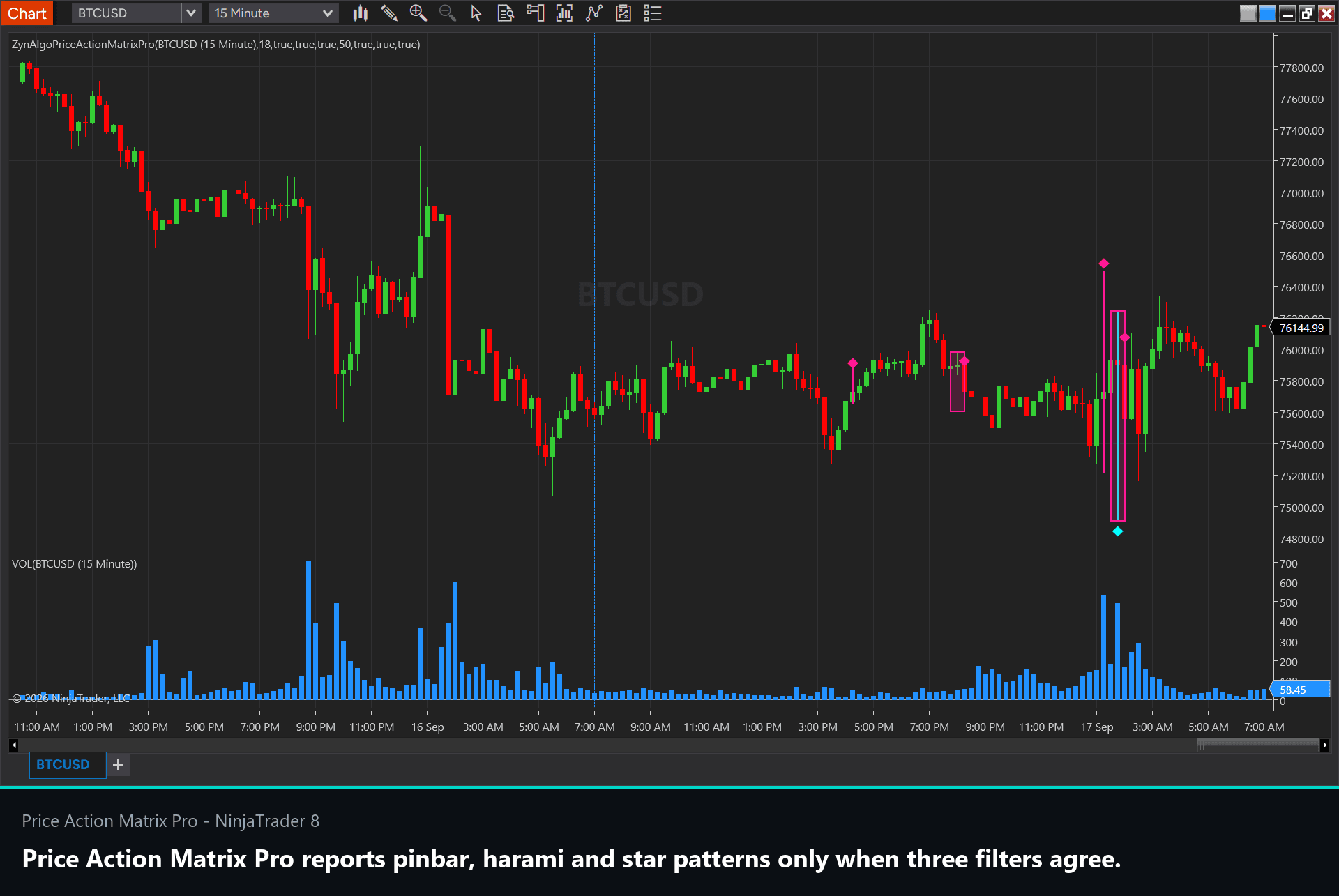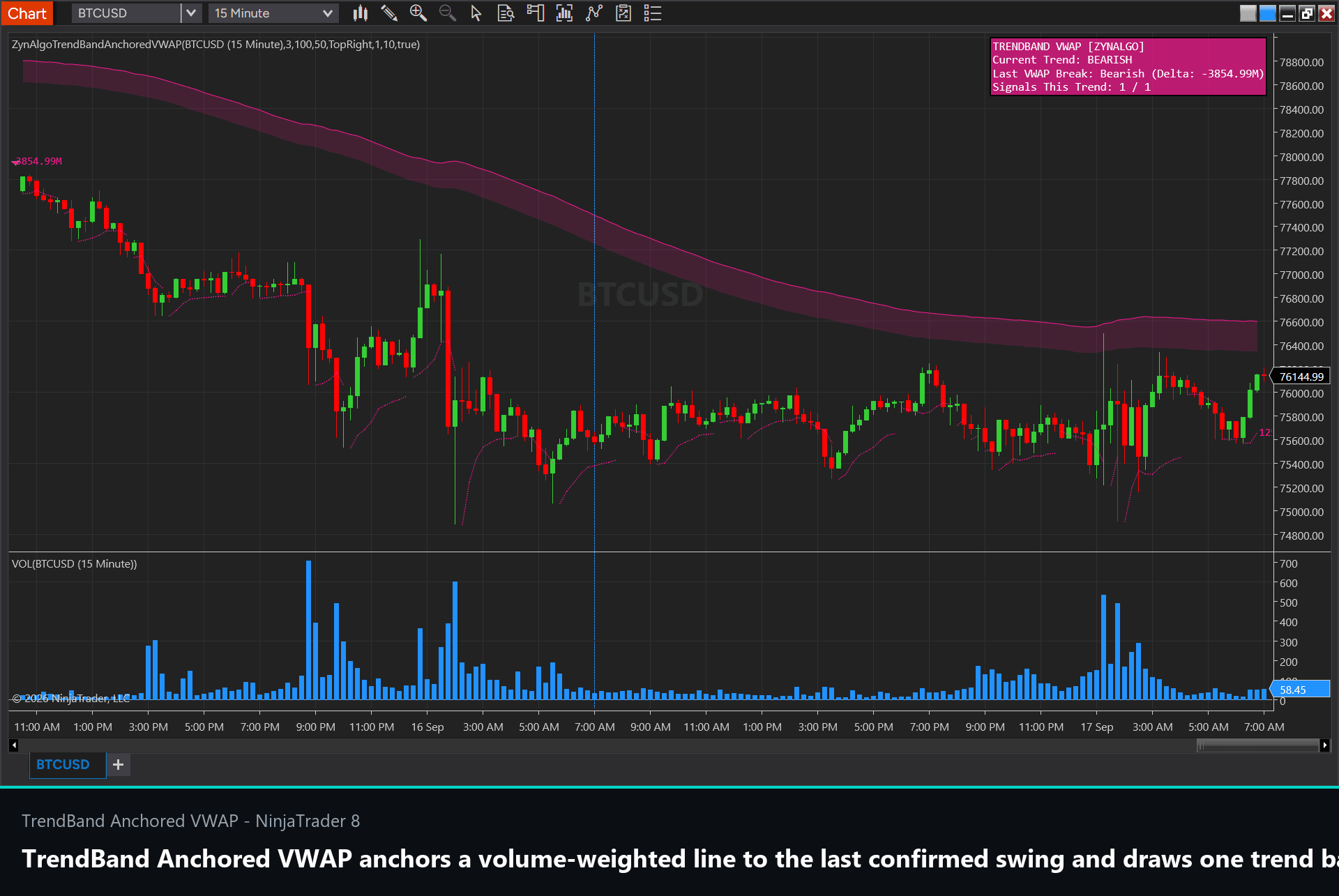
Dynamic SAR Cloud [ZynAlgo]
Stop getting flipped out of a good trend by a single wick. Dynamic SAR Cloud gives the trailing baseline a volatility buffer, so a pullback has to genuinely break the structure before the state changes.
Key benefits
- Noise tolerance: the cloud absorbs wicks and shallow pullbacks that would flip a plain trailing dot.
- Clear re-entries: markers print when a pullback resolves back in the trend direction.
- Built-in bias filter: the cloud colour tells you which side to ignore.
How it works It trails price with a stop-and-reverse baseline, widens it into a cloud using current volatility, then marks the moment price retraces into the cloud and closes back outside it in the trend direction. The full walkthrough is in the Manual.
What's included / Platforms NinjaTrader 8 indicator, lifetime or membership access.
Best for Trend traders on intraday and swing charts who add on pullbacks and want a trailing reference they can hold through noise.
Get started See it on zynassets.com/marketplace.
Disclaimer: Trading involves risk. Markers and cloud boundaries are analytical references and do not guarantee future results.
Dynamic SAR Cloud [ZynAlgo]
What Dynamic SAR Cloud measures, and what it ignores
A trailing stop-and-reverse dot is a decisive tool: price is either above it or below it, and there is nothing in between. That decisiveness is also its problem. A single wick through the dots flips the whole reading, and in normal trading conditions that happens constantly.
Dynamic SAR Cloud keeps the trailing logic but gives it thickness. The baseline still trails price the same way, and around it the tool builds a band whose width comes from current volatility. That band is the cloud.
What the tool measures is the trend state and where the pullback boundary sits. What it deliberately ignores is everything happening inside the cloud, which is exactly where most false flips come from. It also marks the moment a pullback resolves back in the trend direction, on NinjaTrader 8.
Inside Dynamic SAR Cloud: the volatility buffer
The cloud is not decoration. Its width is the tolerance the tool grants a pullback before it accepts that the trend has changed.

- A cloud below price, drawn in the bullish colour, means the market is in an upward state and the cloud is acting as dynamic support.
- A cloud above price, in the bearish colour, means the opposite.
- The colour only changes when price closes decisively through the core, not when a wick touches the edge.
How the buffer width is defined

- The core baseline trails price using the standard acceleration behaviour: it starts slow after a flip and speeds up the longer the trend runs.
- Around that core, a volatility multiplier sets the cloud thickness. A wider setting absorbs deeper pullbacks and keeps you in the trend longer; a tighter one flips sooner.
- The acceleration settings control how closely the core tracks price. Raising the increment makes the whole structure react faster and produces more frequent flips.
This is the trade-off to tune first. A cloud that is too thin gives you the same noise problem the plain version has; too thick and the state persists long after the move is over.
Entry rules with Dynamic SAR Cloud

A marker requires two steps, in order:
- Pullback recognition - price retraces into the cloud, but does not close through the core and break the trend state.
- Continuation confirmation - price turns and closes back outside the cloud boundary in the original trend direction. The marker prints on that bar.
A spacing rule sits on top of both, so a market chopping around the cloud edge produces one marker rather than a cluster.
For risk, the natural reference is just beyond the boundary on the signal bar, since a move past it means the pullback was not a pullback. The tool also includes staged target references derived from volatility and your chosen risk ratio.
There is a second way to use the same structure, and for many traders it is the more valuable one: as a trailing reference for a position you already hold. Follow the cloud boundary while the trend runs, and treat a close through the core that flips the cloud colour as the exit rather than guessing when the move is finished.
Who benefits most from Dynamic SAR Cloud
- Trend traders who want to add to a position on pullbacks rather than at the start of a move.
- Anyone who has used a trailing stop-and-reverse tool and been stopped out by wicks in an otherwise intact trend.
- Traders who want a visible bias filter to stop them taking counter-trend signals from other tools.
The cloud answers one question all the time: is the trend still intact, or has it actually broken. Most of the value is in ignoring everything that happens inside it.
Browse the full ZynAlgo catalogue at zynassets.com/marketplace.
Trading involves risk. Clouds, markers and target references are analytical outputs only, and signals can fail in choppy or news-driven conditions.
- Dynamic SAR Cloud [ZynAlgo] v1Jul 17, 2026
Initial release