Why pullbacks fade before you enter and how ATR trend structure helps
The pullback timing problem
You identify the trend direction, wait for price to pull back, and watch for a signal to rejoin. But by the time the entry marker appears, the shallow retracement has already faded, or worse, the trend itself has reversed. Without a volatility-adjusted structure that defines both the active trend and a qualified pullback state, you are guessing whether the next candle is continuation or reversal.
Adaptive ATR Trend MT5 uses a two-stage ATR engine, Heikin Ashi pullback state, signal cooldown, and a per-trend limit to separate confirmed directional changes from noise and to time pullback entries within an established trend.
How the cascading ATR structure reads trend
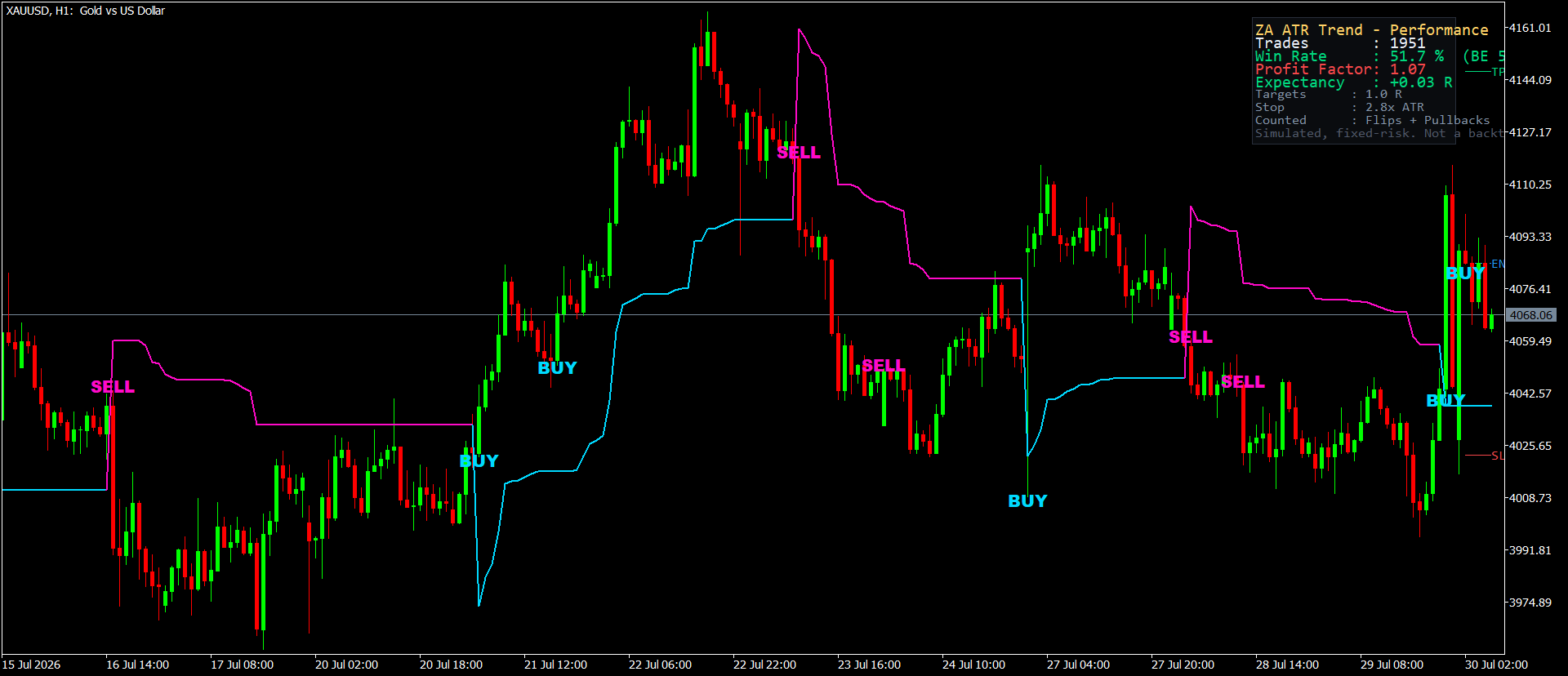
The tool builds trend state in two layers. The first stage calculates a baseline that follows price while adapting to the current ATR, controlled by the ATR Length and Stage 1 Multiplier inputs. The second stage places wider trailing bands around that baseline using the Stage 2 Multiplier. The trend state changes direction only when a closed bar crosses the active trailing boundary.
This cascading design separates a confirmed directional change, where price has moved far enough through volatility-adjusted structure to justify flipping the trend state, from ordinary candle-to-candle fluctuation that stays within the bands.
The trend line color on the chart shows the current bullish or bearish state, so you see at a glance which direction is supported by the ATR structure.
From trend flip to pullback entry
Adaptive ATR Trend produces two kinds of signals, each tied to a different transition. A trend flip signal appears when the closed bar changes the engine from bearish to bullish (BUY trend flip) or from bullish to bearish (SELL trend flip). This marks the moment the ATR structure confirms a new direction.
Once a trend is established, a pullback signal can appear when the Heikin Ashi state turns bullish again during an active bullish trend (BUY pullback) or bearish during an active bearish trend (SELL pullback). Pullbacks must also pass the signal cooldown and maximum-signals-per-trend settings, so you are not flooded with late or redundant entries.
Each marker includes a reason label that distinguishes "Trend flipped bullish" or "Trend flipped bearish" from "Heikin Ashi pullback resumed the active trend." Optional stop-loss and take-profit levels use the signal close as entry, an ATR-multiple stop as 1R, and the enabled R targets you configure.
The on-chart panel is a simplified closed-bar simulation, it tallies how many signals reached their targets and how many hit the stop, but it is not a broker-accurate backtest and does not account for spread, slippage, or partial fills.
Why pullbacks fade before you enter: what this workflow addresses
Without a volatility-adjusted definition of trend direction, you rely on lagging moving averages or visual judgment, and both let reversals masquerade as pullbacks. Without a cooldown or per-trend limit, you enter the fourth or fifth shallow dip in a weakening trend and get stopped out when structure finally breaks.
Adaptive ATR Trend combines the directional filter and the pullback state in one closed-bar tool. You see the confirmed trend flip, then wait for a qualified Heikin Ashi pullback that meets your cooldown and limit rules. The cascading ATR bands and the pullback logic together reduce the chance that you mistake late-stage noise for early continuation.
Who this workflow fits
This tool is built for traders who want trend direction and pullback timing in one chart indicator, who prefer closed-bar confirmation over intrabar repainting, and who trade forex, metals, indices, or crypto across multiple timeframes.
Start with the default inputs, verify behavior on the instrument and timeframe you actually trade, and change one parameter group at a time. Favor repeatable context over signal quantity.
What it does not do
Adaptive ATR Trend does not predict when a pullback will begin or how deep it will run before the Heikin Ashi state flips. It waits for the pullback transition to complete on a closed bar, so the best entry price may already be behind you.
It does not adapt to sudden volatility spikes within a single bar, the ATR calculation is backward-looking, so a news event or gap can trigger a signal after the move is mostly finished.
The tool does not distinguish ranging environments from trending ones. In a tight sideways market, the Stage 2 bands will still flip back and forth, producing trend-flip signals that lead nowhere. You are responsible for filtering those contexts with higher-timeframe structure or another tool.
The on-chart simulation panel counts 1R, 2R, and 3R outcomes, but it does not model real execution. It assumes instant fill at the signal close, zero spread, and no broker rejections. A profitable simulation score does not guarantee the same result in live trading.
Pairing with other tools
Because Adaptive ATR Trend focuses on direction and pullback state, it pairs naturally with entry-refinement tools. Efficiency Step Reentry MT5 can help you time a specific retracement level within the pullback window the ATR engine has already confirmed. CHOP Trend Reentry Signal MT5 adds a choppiness filter to avoid trading during the sideways phases this tool does not natively exclude.
Use complementary tools to refine context, not to multiply signals. Two trend tools running in parallel do not improve results, they create conflicting instructions.
Trading involves risk
Trading forex, metals, indices, and crypto involves substantial risk of loss. Past performance, simulated or real, does not guarantee future results. This indicator is a technical tool, not financial advice, and no setting or combination of settings eliminates the risk inherent in leveraged trading. You are responsible for your own risk management, position sizing, and decision-making.